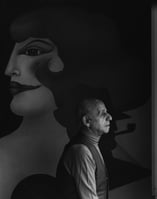
Marilyn Was Here
Analisi esperta di Marilyn Was Here di Richard Lindner
Stile: Mechanistic Cubism · Genere: figurative
Analysis of "Marilyn Was Here" by Richard Lindner
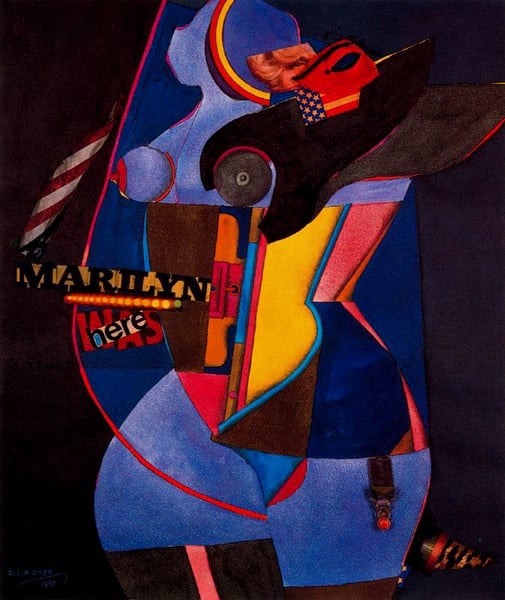
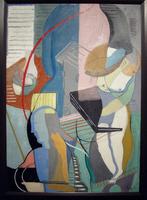
Richard Lindner’s “Marilyn Was Here” stands as a pivotal work within the artist’s idiosyncratic Mechanistic Cubism—a style that fuses the fractured planes of early Cubism with the hard-edged, industrial precision of machine-age aesthetics. Executed in the figurative genre, the painting transforms the iconic Hollywood starlet Marilyn Monroe into a synthetic, almost robotic cipher, stripping away her glamour to reveal a construct of mass media and consumer desire.
Significance within Mechanistic Cubism
Lindner’s approach is distinct from orthodox Cubism. Where Picasso and Braque deconstructed form to explore multiple perspectives, Lindner imposes a rigid, mechanical order. The figure of Monroe is built from interlocking geometric shards—cylinders, trapezoids, and sharp angles—reminiscent of factory parts or mannequins. This “mechanistic” treatment dehumanizes the subject, aligning with Lindner’s broader critique of modern urban life and the commodification of the female body. The title’s casual graffiti-like declaration (“Marilyn Was Here”) further underscores the ephemeral, object-like nature of celebrity: Monroe is reduced to a trace, a mark of presence rather than a human being.
Proto-Pop Art and Cultural Commentary
Painted in the early 1960s, “Marilyn Was Here” predates and predicts the full flowering of Pop Art. Lindner’s cold, airbrushed surfaces and his focus on a mass-media icon directly anticipate Warhol’s silkscreened Marilyns. Yet Lindner retains a darker, more European expressionist undercurrent. The Cubist fragmentation here is not playful but coercive—it suggests a body broken by the machinery of fame. The work thus occupies a unique crossroads: it applies the formal language of early 20th-century avant-garde to the emerging spectacle of mid-century pop culture, creating a bridge between Cubist structural analysis and Pop’s critique of image saturation.
Figurative Innovation
Despite its abstracted geometry, the image remains legibly figurative—a woman’s torso, head, and hair are recognizable. Lindner’s genius lies in making the mechanical feel eerily organic: the curves of Monroe’s silhouette are bisected by ruler-straight lines, and her signature blonde curls are rendered as interlocking metallic discs. This tension between flesh and machine, between the organic and the industrial, defines the work’s emotional charge. It is both a portrait and a dismantling, a celebration and a condemnation.
In sum, “Marilyn Was Here” is significant as a masterwork of Mechanistic Cubism, a style that fuses formal rigor with social critique, and as a prophetic precursor to Pop Art’s interrogation of fame, gender, and the mediated body. Lindner’s Marilyn is not a person but a sign, and his painting forces us to reckon with what it means to be reduced to an icon.
Visivamente simili
20 opere con composizione e palette affini
Coty
Amadeo de Souza-Cardoso
Kompozcija. Sėdinti Moteris
Vytautas Kairiukstis
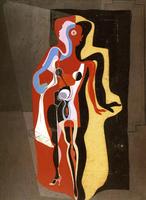
Mannequin (Barcelona Mannequin)
Salvador Dali
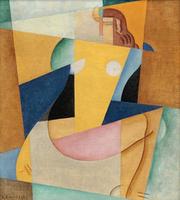
Sitting Woman
Vytautas Kairiukstis
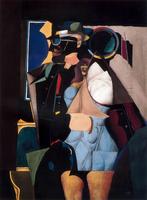
Untitled
Richard Lindner
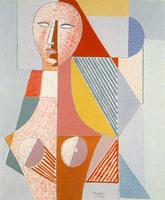
Eternitè
Mario Tozzi
Woman with a Fan II
Olexandr Archipenko
The model
Rene Magritte
THE WOMAN WITH A KEY
Yervand Kochar
Hector and Andromache
Giorgio de Chirico
Woman styling her hair
Pablo Picasso
Couple 2
Richard Lindner
Thirst
Victor Zaretsky

Donna + ambiente
Enrico Prampolini
Odalisque
Corneille
Woman
Richard Lindner
Bust of woman
Pablo Picasso
Promenade
Man Ray
La Ragazza, Il Dado
Mario Tozzi
Abstract with Instruments
Louis Schanker