The Visitor
Analisi esperta di The Visitor di Richard Lindner
Stile: Mechanistic Cubism · Genere: genre painting
Expert Analysis of "The Visitor" by Richard Lindner
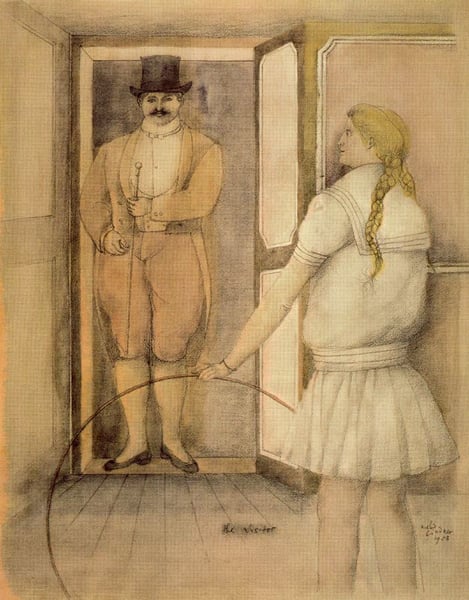
Painted in the mid-20th century, Richard Lindner’s The Visitor stands as a compelling synthesis of Cubist fragmentation and mechanistic precision, defining his distinctive approach within the broader currents of Modernism. The work belongs to Lindner’s self-styled Mechanistic Cubism, a term that captures his transformation of the human figure into an assemblage of hard-edged, geometric components—reminiscent of machine parts, mannequins, or toy-like constructs. This stylistic choice is not merely formal; it reflects Lindner’s commentary on the dehumanizing, artificial quality of modern urban life.
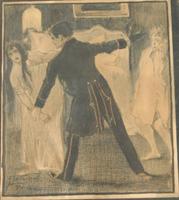
As a genre painting, The Visitor ostensibly depicts an everyday encounter, yet Lindner subverts the traditional genre’s warmth and naturalism. The composition features a sharply defined, nearly monolithic female figure (the visitor) and a smaller, perhaps subservient male figure, rendered with flattened planes, bold outlines, and a restricted, often jarring palette of primary colors. The figures seem frozen in a staged, theatrical space, their gazes and postures ambiguous—suggesting tension, voyeurism, or transactional relationships rather than genuine human connection.
Significance within Mechanistic Cubism and Genre Painting:
-
Pioneering a “Mechanistic” Figuration: Lindner merges the analytical geometry of Cubism (multiple viewpoints, fractured planes) with the clean, impersonal lines of industrial design. Unlike Picasso or Braque, who retained painterly texture, Lindner’s surfaces are sleek and polished, evoking mass-produced objects. This aligns him with the emerging Pop Art sensibility of the 1960s, yet his work remains darker, more psychologically charged—a critique of consumer society’s regimentation of the body and desire.
-
Reinventing Genre Painting: Traditionally, genre painting records everyday life with anecdotal charm. Lindner’s The Visitor turns this on its head: it depicts a quotidian moment (a visitor arriving) but drains it of familiarity, making the scene feel alien, staged, and ritualistic. The figures’ stiff poses and blank, mask-like faces suggest they are performers in an urban theater of roles. This inversion elevates genre painting from mere observation to a psychologically acute, almost surreal social commentary.
-
Influence on Later Artists: Lindner’s Mechanistic Cubism directly anticipates the hard-edge figuration of artists like Alex Katz and the cartoonish robot-like humans of early Pop Art (e.g., Roy Lichtenstein’s mechanical brushstrokes). His ability to blend Cubist structure with a critique of modern alienation makes The Visitor a touchstone for understanding how abstraction and figuration can serve social satire.
In essence, The Visitor is not merely a painting of a visitor—it is a portrait of modern isolation, where individuals become dehumanized constructs navigating a world of artificial interactions. Lindner’s achievement lies in using Cubist logic to express, rather than dissolve, the tension between the mechanical and the human.
Visivamente simili
20 opere con composizione e palette affini
The Visitor
Richard Lindner
Alice
Arthur Rackham
The Westwood Children
Joshua Johnson
Portrait of a child
Léon Augustin Lhermitte

The Preacher
George Harvey
La Patronne
Theophile Steinlen
Cissy Loftus
Henri de Toulouse-Lautrec
A doorman doesn't permit Tchitchikov to visit a governor
Marc Chagall
Indiscreet servant (front)
Eduardo Zamacois
To Aï Bonenfant Rendezvous
Nicolas Toussaint Charlet
Illustration to "A Week of Kindness"
Max Ernst
The arrival of a governess in a merchant's house
Vasily Perov
Scheiber Hugó, Zenészek 1944
Scheiber Hugó
Myself in Brussels
Otto Dix
Family Portrait
Otto Dix
a Barber Smoking a Pipe
Hendrick Avercamp
Il giocoliere
Antonio Donghi
Two Women and a Child
John Flaxman
The Old Man and the Children
Nicolas Toussaint Charlet
Le Fils inscribed to Sainte Croix
Theophile Steinlen