
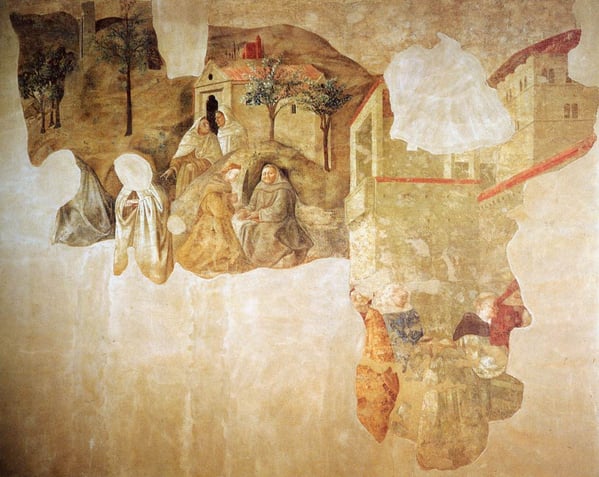
Analisi esperta di Confirmation of the Carmelite Rule di Filippo Lippi
Stile: Early Renaissance · Genere: religious painting
Expert Analysis: "Confirmation of the Carmelite Rule" by Filippo Lippi
This religious painting, executed in the Early Renaissance style, holds significant value for several reasons tied to its period and subject matter.
1. Synthesis of Spiritual Narrative and Humanist Naturalism
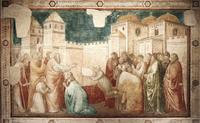
As an Early Renaissance work, Lippi’s painting bridges the medieval Gothic tradition of icon-like devotional imagery with the emerging humanist interest in naturalism and emotional accessibility. The scene—the confirmation of the Carmelite Rule—is not merely a static hierarchy of saints or donors, but a narrative moment rendered with believable spatial depth, anatomically proportioned figures, and facial expressions that convey spiritual gravity and individual presence. This shift toward a more earthly, relatable sacred story is a hallmark of the period.
2. Personal and Institutional Significance
Lippi himself was a Carmelite friar, lending the subject deep autobiographical resonance. The painting serves as both a historical document of the Carmelite order’s foundational moment and a testament to Lippi’s own monastic identity. In the Early Renaissance, such personal connections between artist and subject were increasingly valued, as art moved from anonymous workshop production toward individual authorship and psychological insight.
3. Compositional and Stylistic Innovation
Typical of the Early Renaissance, Lippi likely employs clear linear perspective to organize the crowded religious scene, guiding the viewer’s eye toward the central act of confirmation. The use of light, shadow, and luminous color—reflective of the period’s oil and tempera techniques—creates volume and a sense of tangible space. The placement of figures in a layered foreground and background demonstrates the era’s growing sophistication in rendering three-dimensionality on a flat surface.
4. Religious and Social Context
The subject—papal or episcopal confirmation of a monastic rule—was of acute relevance to 15th-century viewers, who lived amid vibrant debates about ecclesiastical authority and reform. By framing this moment with grace and clarity, Lippi affirms the legitimacy of the Carmelite tradition while celebrating the unity of sacred and temporal power. The painting thus functions as both a devotional aid and a political statement, a duality typical of Early Renaissance religious art.
In sum, "Confirmation of the Carmelite Rule" is significant for its masterful blend of devotional sincerity and new pictorial techniques, its intimate connection to the artist’s own life, and its role in illustrating the transformative ideals of the Early Renaissance—where the divine is made tangible through human form and natural space.
Visivamente simili
20 opere con composizione e palette affini
Confirmation of the Carmelite Rule
Filippo Lippi
A Young Man Being Introduced to the Seven Liberal Arts
Sandro Botticelli
Fresco in the Karmeliterkloster, Frankfurt am Main
Jerg Ratgeb
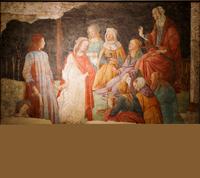
Young Man Greeted by Seven Liberal Arts
Sandro Botticelli
Procession of the Queen of Sheba and Meeting between the Queen of Sheba and King Solomon
Piero della Francesca
Scene of peace offerings, Noah's drunkenness and shame
Paolo Uccello
Tabernacle of the Visitation: Annunciation to Joachim
Benozzo Gozzoli
The Vintage and Drunkenness of Noah
Benozzo Gozzoli
Finding of the True Cross
Piero della Francesca
Processione di Sisto IV (detail)
Antoniazzo Romano
Processione di Sisto IV (detail)
Antoniazzo Romano
Finding and Recognition of the True Cross
Piero della Francesca
Scenes with St. Ambrose
Benozzo Gozzoli
Venus and the Graces offering gifts to a young girl
Sandro Botticelli
Scenes of Monastic Life
Paolo Uccello
Allegory of March – Triumph of Minerva and Sign of Aries. Frescos in Palazzo Schifanoia (detail)
Francesco del Cossa
Allegory of May – Triumph of Appolo. Frescos in Palazzo Schifanoia (detail)
Francesco del Cossa
The Crucifixion
Luca Signorelli
Madonna and Child
Andrea del Castagno
Raising of Drusiana
Giotto