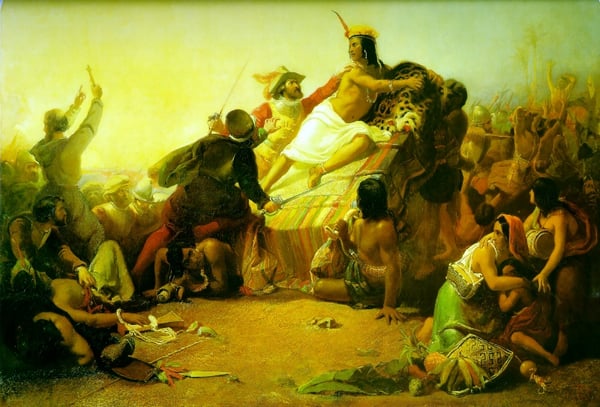
Analisi esperta di Pizarro Seizing the Inca of Peru di John Everett Millais
Stile: Romanticism · Genere: history painting
Expert Analysis of Pizarro Seizing the Inca of Peru by John Everett Millais
Despite John Everett Millais’s later fame as a founding member of the Pre-Raphaelite Brotherhood, this early work aligns with the Romantic style through its intense emotionalism, dramatic chiaroscuro, and fascination with the exotic and the sublime. As a history painting—then considered the highest genre of academic art—the work serves not merely as a record but as a moral and emotional tableau.
Significance within Romanticism:
The painting seizes on a pivotal, violent moment of cultural collision: the 1532 capture of Inca Emperor Atahualpa by Spanish conquistador Francisco Pizarro. Romantic history painting privileged such turning points, where individual heroism, tragedy, or national destiny hung in the balance. Here, Millais emphasizes the pathos of the doomed Inca—his regal bearing under duress—contrasting with the cold, armored Europeans. This sympathy for the “noble savage” and critique of imperial aggression are hallmarks of Romanticism’s engagement with non-European cultures and its distrust of Enlightenment rationalism. The dramatic tension is heightened by Millais’s use of light and shadow: a lurid, almost theatrical illumination picks out the Inca’s golden ornaments and the gleam of Spanish steel, evoking both the lure of El Dorado and the brutality of conquest.
Significance as a History Painting:
History painting in the Romantic era aimed to instruct through emotion, not merely document. Millais compresses the narrative into a single, kinetic instant—the seizure itself—making the viewer a witness to raw power and vulnerability. The composition balances chaos (the scramble of soldiers, the flaring torches) with a central, almost static confrontation between Pizarro and Atahualpa, granting the scene a monumental, almost allegorical weight. The work also reflects the 19th-century British appetite for imperial adventure narratives, yet transcends propaganda by foregrounding the human cost.
Why It Matters:
- It exemplifies Romanticism’s shift from neoclassical idealization to emotionally charged, even sensational storytelling.
- It demonstrates the young Millais’s precocious mastery—his ability to render rich textures (metal, feathers, cloth) and complex crowd scenes while maintaining a unified dramatic focus.
- The painting captures a moment of world-historical rupture, making it a visual meditation on power, destiny, and the clash of civilizations—themes that remain resonant.
In sum, Pizarro Seizing the Inca of Peru is significant as a vivid Romantic history painting that uses theatrical composition, empathetic characterization, and historic drama to interrogate both the glory and the guilt of empire.
Museum / Gallery
Visivamente simili
20 opere con composizione e palette affini
Crusaders Thirsting near Jerusalem
Francesco Hayez
Revolt in Cairo (on) 21 October 1798
Anne-Louis Girodet
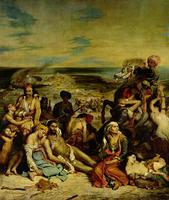
The Massacre at Chios
Eugene Delacroix
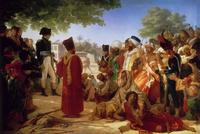
Napoleon Bonaparte Pardoning the Rebels at Cairo, 23rd October 1798
Pierre-Narcisse Guerin
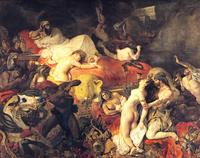
Death of Sardanapalus
Eugene Delacroix
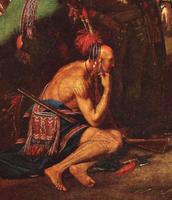
The Death of General Wolfe (detail)
Benjamin West
John Smith Saved by Pocahontas
Alonzo Chappel
Song of songs
Gustave Moreau
The Martyrdom of the Holy Innocents
Gustave Dore
The Landing of Roger Williams in 1636
Alonzo Chappel
Rudolf von Habsburg on the body of Přemysl Ottokar, King of Bohemia
Anton Romako
Perseus Fighting Phineas and His Companions
Luca Giordano
German Artists Make Their Sketches in Rome
Wilhelm von Kaulbach
Samson
Solomon Joseph Solomon
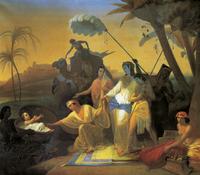
Pharaoh's daughter finding baby Moses
Konstantin Flavitsky
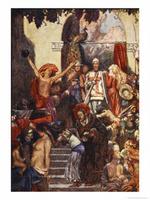
At the Town There was a Vanity Fair Keptthe Pilgrims Progress
Byam Shaw
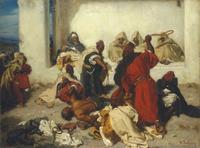
The captured thief
Alfred Dehodencq
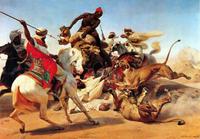
The Lion Hunt
Horace Vernet
Death of the Greek hero Markos Botsaris
Jean-Charles Langlois
Christian martyrs in the Colosseum
Konstantin Flavitsky