Expertenanalyse zu John Everett Millaiss Sweetest eyes that were ever seen…
Stil: Realism · Genre: portrait
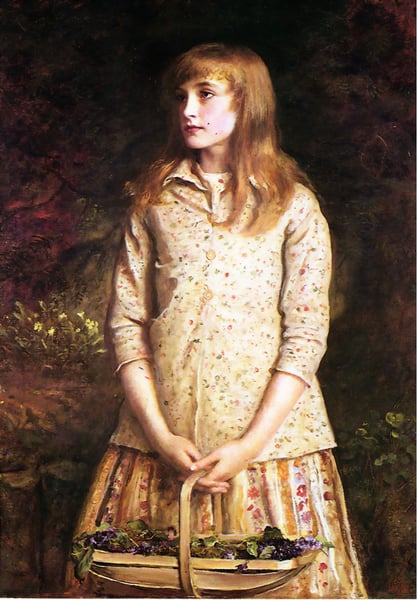
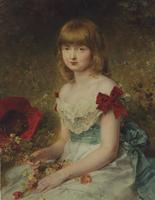
John Everett Millais’s “Sweetest eyes that were ever seen…” (c. 1879) is a captivating portrait that exemplifies the artist’s mature Realist style while retaining the vivid detail and emotional intensity of his Pre-Raphaelite roots. Although Millais is best known as a founding member of the Pre-Raphaelite Brotherhood, by the 1870s his work had evolved into a more naturalistic, broadly Realist approach—yet this painting reveals his enduring fascination with capturing the subtleties of human expression and tactile textures.
Significance within Realism and portrait tradition:
The painting’s title, drawn from a line by the Irish poet Thomas Moore, immediately frames the subject’s eyes as the emotional and compositional focus. Millais renders them with extraordinary delicacy: the iris’s flecks of color, the soft shadow beneath the lid, the subtle reflection of light—all executed with a precision that transcends mere likeness. This devotion to optical truth—a hallmark of Realism—is paired with a psychological depth that elevates the portrait beyond a simple visual record. The sitter’s gaze is both inviting and introspective, creating an intimate dialogue with the viewer.
Millais’s brushwork here is notably refined. The skin tones are built with translucent layers that convey the warmth and softness of flesh, while the costume—likely a velvet or silk fabric—is rendered with just enough detail to suggest luxury without distracting from the face. This balance between meticulous finish and painterly economy marks a key transitional moment in Millais’s career, bridging the hyper-detailed Pre-Raphaelite style and the broader, more atmospheric Realism that would dominate later Victorian portraiture.
Why this work matters:
“Sweetest eyes that were ever seen…” stands as a testament to Millais’s ability to synthesize technical virtuosity with poetic sentimentality—a combination that made him one of the most commercially successful and critically respected portraitists of his era. The painting also reflects the Victorian fascination with idealized femininity, yet it avoids cliché by grounding the sitter in a believable, un-idealized presence. In its fusion of scientific observation of the eye (a favorite subject for Realists studying perception) and romantic sensibility, the work encapsulates the complex aims of late-19th-century Realism: to see clearly, but to see with feeling.
For art historians, this portrait is a key example of how Millais—and the broader Realist movement—could take a simple, intimate moment and elevate it into a universal meditation on beauty, memory, and the power of the human gaze.
Museum / Gallery
Visuell ähnlich
20 Werke mit ähnlicher Komposition und Farbpalette
Portrait Of Gracia Lees
John Everett Millais
Phyllis Waterlow
John William Waterhouse
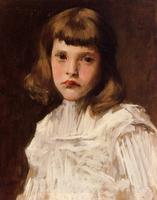
Portrait of Dorothy
William Merritt Chase
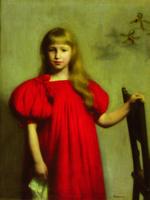
Portrait of a Girl in a Red Dress (józefa Oderfeldówna)
Józef Pankiewicz
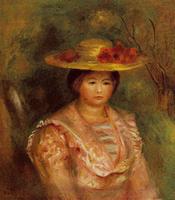
Bust of a Woman (Gabrielle)
Pierre-Auguste Renoir
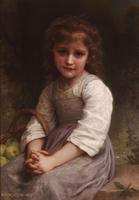
Apples
William-Adolphe Bouguereau
Little Lizie Lynch
Julian Alden Weir
Portrait of a Young Girl
Alexei Harlamoff
Goldwynne
William Logsdail
Daydreaming
Filadelfo Simi
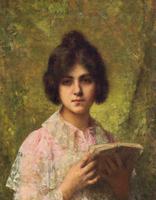
A young woman holding a book
Alexei Harlamoff
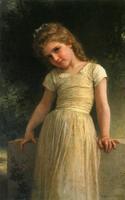
Elpieglerie
William-Adolphe Bouguereau
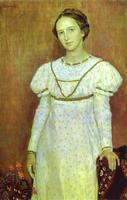
Portrait of Olga Poletayeva
Viktor Vasnetsov
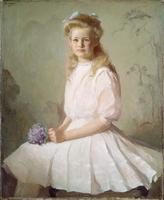
Katharine Gray Dodge
Frank W. Benson
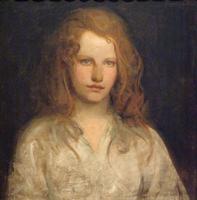
Margaret MacKittrick
Abbott Handerson Thayer
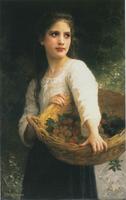
The Plums
William-Adolphe Bouguereau
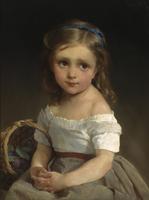
Girl with basket of plums
Émile Munier
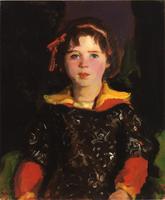
Bridgie (also known as Girl with Chinese Dress)
Robert Henri
Spring
Ludwig Knaus
Petite fille en robe rouge
Jean Benner