Expert analysis of Gustave Moreau’s Orestes and the Erinyes
Style: Symbolism · Genre: mythological painting
Expert Analysis: "Orestes and the Erinyes" by Gustave Moreau
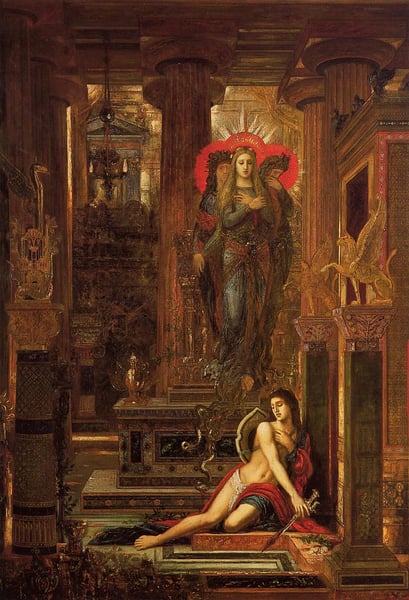
Gustave Moreau’s Orestes and the Erinyes stands as a quintessential expression of the Symbolist movement, reimagining a foundational Greek myth through a lens of psychological intensity and mystical beauty. The work’s significance lies in how Moreau transforms a classical narrative of guilt and divine punishment into an internal, almost hallucinatory drama—hallmark of Symbolism’s rejection of literal storytelling in favor of the suggestive and the subjective.
Moreau selects a moment of profound torment: Orestes, having avenged his father by killing his mother Clytemnestra, is hounded by the Erinyes (Furies), the goddesses of vengeance. In Moreau’s hands, the Furies are not mere monstrous pursuers; they are spectral, almost decorative presences that blur the boundary between external persecution and internal anguish. The artist’s meticulous, jewel-like technique—layered glazes, intricate patterns, and a glowing, otherworldly palette—imbues the scene with a dreamlike stillness. Orestes appears less as an active hero and more as a passive vessel of fate, his posture slumped, his gaze inward. The Erinyes, often rendered with serpentine hair and dark wings, seem to emerge from the very architecture of the composition, suggesting that the horror is as much architectural (a labyrinth of the mind) as it is mythological.
What makes this work significant is its role in breaking from academic naturalism and narrative clarity. Moreau prioritizes atmosphere and allegory: the painting becomes a meditation on conscience, ancestral curse, and the impossibility of escape from moral law. The dense symbolism—the snake motifs, the shadowy palace, the hint of sacrificial blood—creates what Symbolists called a “decorative essentiality,” where every detail is loaded with meaning yet refuses easy interpretation. This approach deeply influenced later Symbolist poets (like Mallarmé) and painters (such as Redon and the Nabis), establishing Moreau as a bridge between Romanticism’s emotional excess and Modernism’s psychological depth. In Orestes and the Erinyes, myth is not retold; it is re-felt as a universal nightmare.
Museum / Gallery
Visually similar
20 works with related composition and palette
Salome dancing before Herod
Gustave Moreau
Susanna and the Elders
Gustave Moreau
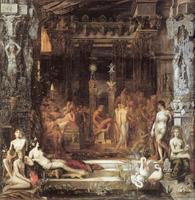
The Daughters of Thespius
Gustave Moreau
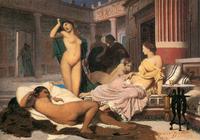
Greek Interior (Gyneceum)
Jean-Leon Gerome
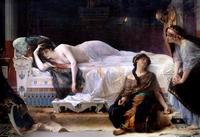
Phedre
Alexandre Cabanel
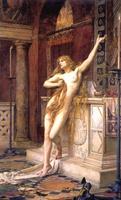
Hypatia
Charles William Mitchell
Greek Interior (Gyneceum)
Jean-Leon Gerome
Private baths in Pompeii
Fyodor Bronnikov
Antiochus and Stratonice
Jean Auguste Dominique Ingres
Socrates seeking Alcibiades in the House of Aspasia
Jean-Leon Gerome
The Bath
Ettore Forti
King Candaules of Lydia
Jean-Leon Gerome
Hercules and Omphale
Charles Gleyre
Paris and Helen
Jacques-Louis David
Feast of Belshazzar
Ivan Tvorozhnikov
Diadumenè
Edward Poynter
The Bath
Charles Gleyre
Two Boys Presented to Diana with the Three Graces Beyond
Henri-Pierre Picou
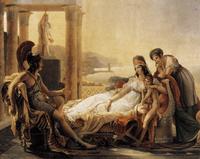
Aeneas Tells Dido the Misfortunes of the Trojan City
Pierre-Narcisse Guerin
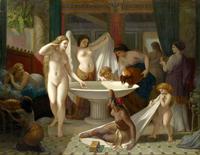
Jeunes Femmes Au Bain
Henri-Pierre Picou