Expert analysis of Aleksey Savrasov’s Sea
Style: Realism · Genre: landscape
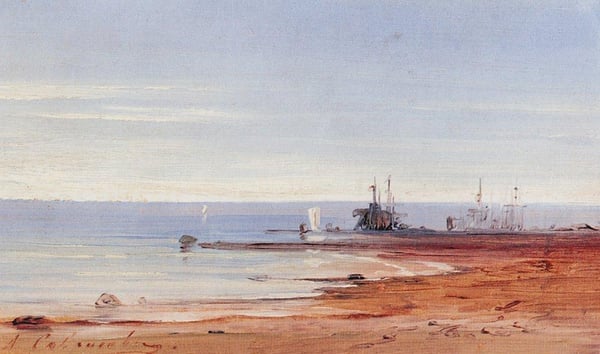
Aleksey Savrasov’s “Sea” is a masterful example of 19th-century Russian Realist landscape painting, notable for its ability to transform a seemingly simple coastal scene into a deeply atmospheric and emotionally resonant meditation on nature. Executed in the artist’s mature style, the work exemplifies the core tenets of Realism—truthful observation, fidelity to natural light and weather, and a rejection of idealized composition—while simultaneously elevating the genre beyond mere documentary record.
Composition and Technique The painting captures the vast, shifting expanse of the sea under a low, brooding sky. Savrasov employs a restrained palette of muted greens, grays, and pale blues, with subtle flecks of white for breaking waves and clouds. The horizon is deliberately low, allowing the viewer’s eye to travel across the water’s rhythmic surface, while the foreground may include a strip of shore or rocks that anchor the scene in tactile reality. Brushwork varies from broad, sweeping strokes for the sky to finer, more broken touches for the water, creating a sense of constant motion and transient light. The atmosphere is cool and humid, evoking the specific climate of the Russian or Baltic coast.
Significance within Realism and Landscape Tradition Savrasov’s “Sea” is significant for several reasons:
-
Poetic Naturalism: Unlike many Western European marines that emphasized dramatic storms or grandiose shipwrecks, Savrasov’s sea is quiet, almost contemplative. He focuses on the ordinary, ephemeral moments—the gentle swell of waves, the soft diffusion of light through clouds—that reveal the inherent beauty of everyday nature. This approach aligns with the Peredvizhniki (Wanderers) movement, of which Savrasov was a founding member, who sought to depict the truth of Russian life and landscape with sincerity and national identity.
-
Emotional Atmosphere: The work transcends description through its mood. The muted tones and subtle gradations of light create a sense of solitude, melancholy, and vastness—qualities that would later influence artists like Isaac Levitan and Ivan Shishkin. Savrasov’s sea is not just a body of water; it is a space for introspection, a mirror of the human soul.
-
Mastery of Light and Weather: Savrasov’s ability to capture the fleeting effects of atmospheric conditions—the damp air, the diffused sunlight breaking through clouds—demonstrates his deep understanding of plein-air observation. This attention to transient phenomena was revolutionary for Russian landscape painting, moving it away from academic clichés toward a more immediate, authentic vision.
-
Pioneering Russian Landscape Identity: At a time when many Russian artists looked to Italy or France for inspiration, Savrasov rooted his work in the understated grandeur of the native landscape. “Sea” exemplifies his belief that even the most humble stretch of coastline could convey a profound sense of place and national spirit.
In sum, “Sea” is a hallmark of Savrasov’s legacy: a realist landscape that is as much about the inner life of the viewer as it is about the external world, and a quiet testament to the power of nature seen through the lens of truth and emotion.
Visually similar
20 works with related composition and palette
Volga
Aleksey Savrasov
The Shore. Cloudy Day
Fyodor Vasilyev
Volga
Aleksey Savrasov
Note in Blue and Opal
James McNeill Whistler
The Norman coast
Richard Parkes Bonington
Landscape near Quilleboeuf France
Richard Parkes Bonington
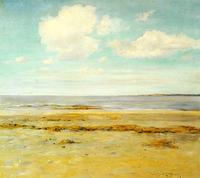
The Deserted Beach
William Merritt Chase
Delaware River Scene
Thomas Eakins
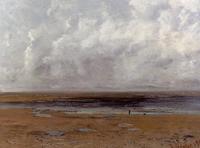
The Beach at Trouville at Low Tide
Gustave Courbet
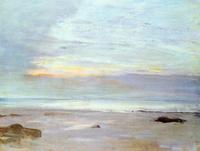
Crepuscule in Opal Trouville
James McNeill Whistler
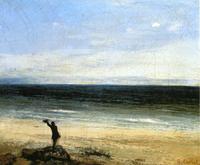
The Beach at Palavas
Gustave Courbet
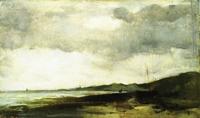
Coastal View
John Henry Twachtman
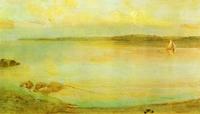
Gray and Gold - The Golden Bay
James McNeill Whistler
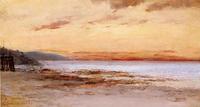
The Beach at Trouville
Gustave Courbet
The Evening Star
J.M.W. Turner
Sea shore in the vicinity Oranienbaum
Aleksey Savrasov
Open Bay, Hudson River
Leon Dabo
Landscape near Quilleboeuf
Richard Parkes Bonington
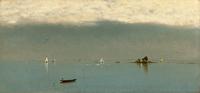
Passing off of the Storm
John Frederick Kensett
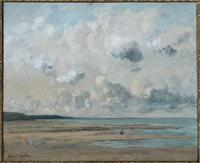
Shores of Normandy
Gustave Courbet