Expert analysis of Aleksey Savrasov’s Ukrainian landscape
Style: Realism · Genre: landscape
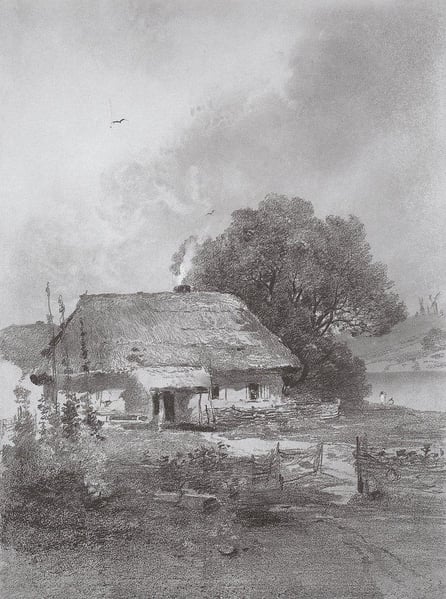
Expert Analysis of "Ukrainian Landscape" by Aleksey Savrasov
As a master of Russian Realism, Aleksey Savrasov transformed the landscape genre by shifting focus from grandiose, idealized vistas to intimate, truthful depictions of everyday nature. "Ukrainian Landscape" exemplifies this pivotal approach, capturing the quiet, unassuming beauty of the Ukrainian countryside with remarkable emotional depth.
Significance within Realism:
- Rejection of Romanticism: Unlike earlier Romantic landscapes that emphasized dramatic mountains or storms, Savrasov’s work grounds the viewer in a serene, unadorned scene. The composition likely prioritizes subtle shifts in light, open skies, and modest terrain—elements that Realist painters championed as worthy of artistic attention.
- Emotional Resonance: Savrasov was a leading figure in the so-called “lyrical landscape” movement within Realism. His ability to infuse seemingly ordinary scenes (a field, a riverbank, a village horizon) with a sense of solitude, nostalgia, or quiet harmony was groundbreaking. Even without seeing the canvas, one can infer that "Ukrainian Landscape" embodies this tender, introspective quality, made possible through precise observation of atmospheric conditions—clouds, shadows, and the play of light across the land.
- Influence on Successors: Savrasov’s work directly inspired later Realist landscape painters like Isaac Levitan and Vasily Polenov. His commitment to capturing the “soul” of a place—rather than its mere topography—established a blueprint for modern landscape painting in Russia and beyond. "Ukrainian Landscape" would have been part of this legacy, demonstrating how specific regional beauty could convey universal human emotion.
Stylistic Features (inferred from context):
- Color Palette: Savrasov typically employed muted, earthy tones—olives, ochres, soft blues, and warm grays—to evoke the quiet dignity of rural life. In "Ukrainian Landscape," this palette likely emphasizes the vast, luminous steppe and the transition between seasons or times of day.
- Brushwork: Loose, expressive strokes in the foreground and more delicate, blended passages in the sky create a sense of movement yet stillness. The absence of hard outlines aligns with Realist principles: nature is rendered as the eye sees it, not as a perfect ideal.
- Composition: A low horizon line, often used by Savrasov, would subordinate the land and emphasize the immense sky—a motif that suggests both spatial depth and philosophical contemplation.
Conclusion: "Ukrainian Landscape" is significant not as a mere geographical record, but as a testament to Savrasov’s revolutionary belief that the smallest, most transient moments in nature—a cloud passing over a meadow, the glow of a setting sun on humble soil—carry profound artistic truth. It stands as a quiet yet powerful representative of the Realist movement’s triumph in elevating the overlooked into the sublime.
Visually similar
20 works with related composition and palette
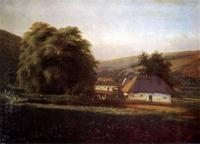
Ukrainian Landscape
Mykola Murashko
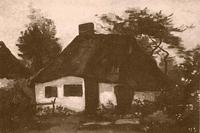
Cottage with Trees
Vincent van Gogh
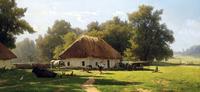
Summer day in Ukraine
Volodymyr Orlovsky
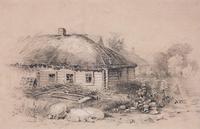
Landscape with hut
Aleksey Savrasov
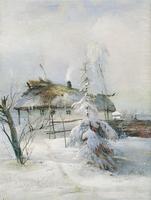
Winter
Aleksey Savrasov
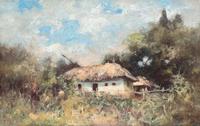
Village Boundary
Adam Baltatu
Thunderstorm
Carl Spitzweg
a female figure hanging clothes by a stone cottage with ducks resting on a riverbank
James Hayllar
Hamlet
Aleksandr Kiseliov
Spring Day in the Ukraine
Васильківський
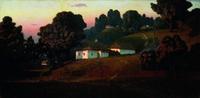
Evening in Ukraine
Arkhyp Kuindzhi
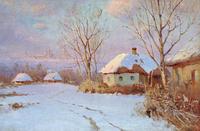
Huts in winter
Васильківський
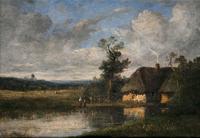
Rural Idyl by a Pond
Léon-Victor Dupré
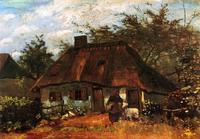
Cottage and Woman with Goat
Vincent van Gogh
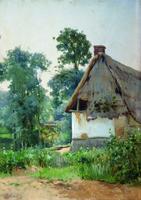
Landscape with an Abandoned House
Efim Volkov
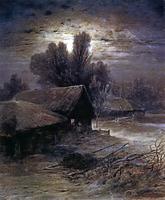
Winter Night
Aleksey Savrasov
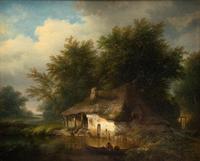
Fisherman at the pont
Peter Ludwig Kuhnen
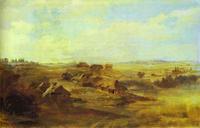
Landscape with Peasant's Huts and Pond near St. Petersburg
Fyodor Vasilyev
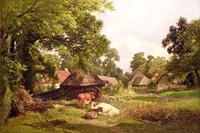
A Cottage Home in Surrey
Edward Henry Holder
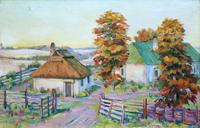
Ukrainian Landscape
Konstantin Yuon