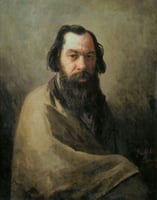
Expertenanalyse zu Aleksey Savrasovs Waterfall
Stil: Realism · Genre: landscape
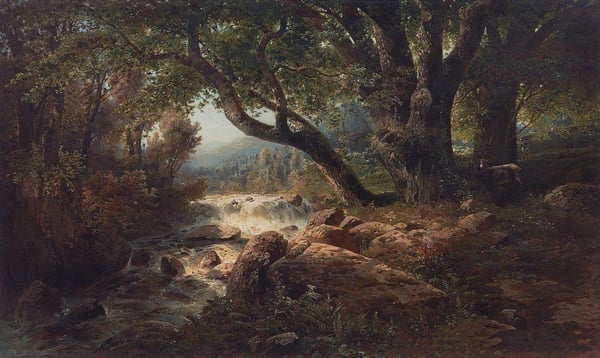
Expert Analysis of "Waterfall" by Aleksey Savrasov
Aleksey Savrasov stands as a pivotal figure in 19th-century Russian Realism, and his landscape "Waterfall" is a compelling demonstration of the movement’s core ambition: to capture nature not as an idealized stage, but as a living, breathing entity. Executed in the Realist style, the painting transcends mere topographical documentation, achieving a profound atmospheric lyricism that would deeply influence the later Peredvizhniki (The Wanderers).
Significance within Realism and Landscape Painting
Savrasov’s genius lies in his ability to elevate the ordinary. While many Realist landscapes of the era focused on grand vistas or dramatic historical sites, Savrasov often turned to humble, intimate corners of the Russian countryside. "Waterfall" is significant for its masterful treatment of movement and light. The cascading water is not rendered with stiff, academic precision, but with a dynamic, almost impressionistic touch—suggesting the roar and spray of the falls through broken brushstrokes and nuanced tonal shifts from white to deep blue-green.
The composition typically leads the viewer’s eye from the dark, shadowed foreground (often featuring mossy rocks or fallen trees) into the luminous, churning center of the falls, and then upward to the soft, diffused sky. This movement creates a sensory experience: one can feel the cool mist and hear the constant rush. Savrasov’s Realism is not about photorealism; it is about emotional truth. He captures the transient effects of weather and light—perhaps the sun breaking through clouds after a rain, reflecting off wet stone and water—to evoke a mood of sublime tranquility tinged with a quiet melancholy.
What Makes This Work Significant
-
Pioneering the "Mood Landscape": Savrasov is often credited with establishing the "peyzazh nastroeniya" (landscape of mood) in Russian art. "Waterfall" exemplifies this: the scene’s emotional resonance—awe mixed with solitude—is as important as the accurate depiction of the cascade. This approach broke from the earlier Romantic landscapes that often foregrounded human drama or national symbolism.
-
Technical Innovation in Water Depiction: The treatment of falling water in this work is noteworthy. Avoiding the clichéd white streaks of earlier painting, Savrasov layers translucent glazes and short, directional strokes. The foam, mist, and splashes are constructed from a palette of silvery grays, whites, and pale blues, creating a sense of volume and transparency that feels remarkably modern.
-
Influence on Russian Art: Savrasov’s landscapes, including "Waterfall," directly inspired his students (such as Isaak Levitan) and the broader Realist movement. By demonstrating that a humble forest stream or a secluded waterfall could carry profound spiritual weight, he expanded the vocabulary of Russian landscape painting. This work stands as a testament to his belief that nature itself is the most powerful subject—honest, unadorned, and deeply moving.
In "Waterfall," Savrasov achieves a perfect synthesis of Realist observation and lyrical sensibility. It is a painting that invites quiet contemplation, a hallmark of his enduring legacy in the canon of Russian Realist landscape.
Visuell ähnlich
20 Werke mit ähnlicher Komposition und Farbpalette
Landscape with a Stream
Andreas Achenbach
Forest landscape with river and goats
Johann Gottfried Steffan
Autumn Wood
William Hart
Forest landscape Sun
Theodore Rousseau
A Mountain Stream
Thomas Moran
Landscape with Waterfall
Salomon van Ruysdael
The Emerald Pool
Albert Bierstadt
Autumn, New Hampshire
William Hart
Solitude
Thomas Moran
White Mountains, New Hampshire
Albert Bierstadt
A Scene on the Tohickon Creek
Thomas Moran
View in the Neighbourhood of Oranienbaum
Aleksey Savrasov
Trout Fisherman
John Frederick Kensett
A Creek in the Woods
Asher Brown Durand
Mountain Pool
Ralph Blakelock
Landscape with Waterfall
Jacob van Ruisdael
the Sketcher
Asher Brown Durand
Edge of the Forest
Ivan Shishkin
Harzlandschaft bei Ilsenburg mit alter Eiche
Georg Heinrich Crola
A Natural Monarch
Asher Brown Durand