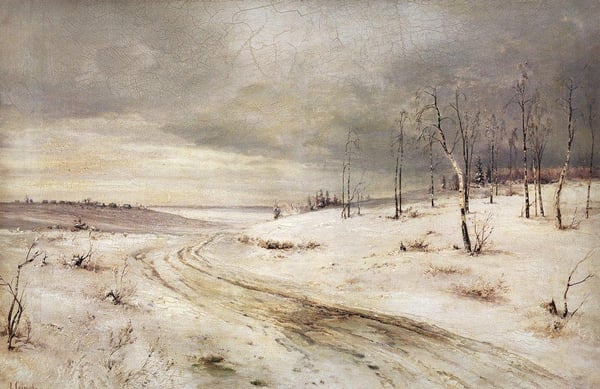
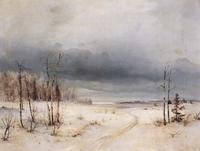
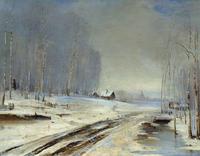
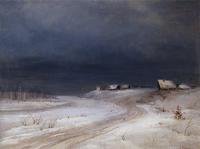
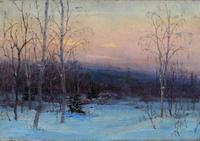
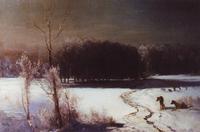
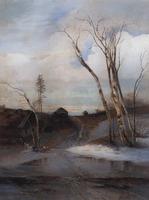
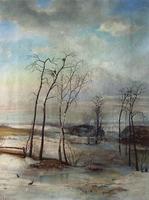
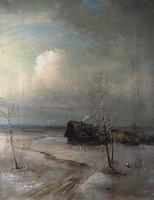
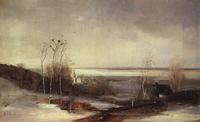
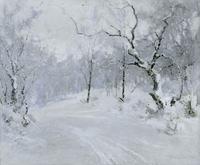
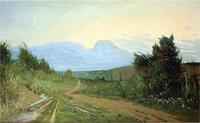
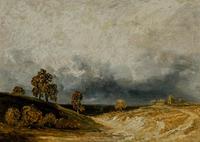
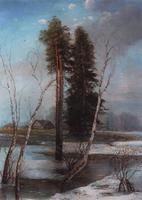
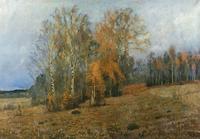
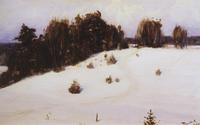
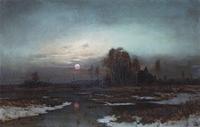
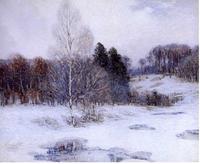
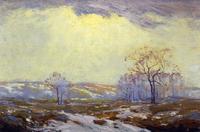
The artwork "Winter Road" by Aleksey Savrasov exemplifies the Realist landscape tradition, though its true significance lies in how the artist transforms a mundane rural scene into a poignant meditation on the Russian environment and human solitude. Savrasov, a founding member of the Peredvizhniki (The Wanderers) movement, rejected the idealized, academic landscapes of his predecessors in favor of unvarnished truths found in everyday life. Here, the composition’s low horizon and muted, silvery palette evoke the vast, unbroken expanse of a snow-covered plain. The track—a humble, winding road—cuts through the white silence, suggesting both journey and isolation.
What makes this work enduring is Savrasov’s masterful use of atmospherics to convey a specific kind of national melancholy. The pale winter light, diffuse and cold, softens the contours of bare trees and distant fields, while subtle tonal variations in the snow—from blue-tinged shadows to warmer patches touched by a weak sun—capture a fleeting moment of quiet transition. Unlike later, more dramatic Russian landscapes (by Levitan or Shishkin), Savrasov’s “Winter Road” avoids grand spectacle; instead, its power is in the lyrical simplicity that elevates the ordinary to the sublime. The work stands as an early, influential example of how the Peredvizhniki’s Realism could be deeply poetic, grounding emotional resonance in the specific, often overlooked details of Russian soil and sky.