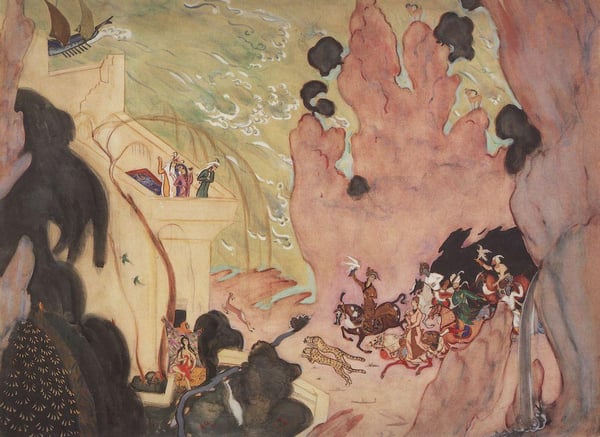
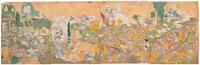
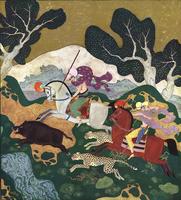
This curtain design by Valentin Serov for Rimski-Korsakov’s ballet Sheherezade is a significant work within the Art Nouveau (Modern) movement, particularly in the realm of stage and decorative design. Executed in a style that prizes sinuous, organic lines and lush ornamentation, Serov’s composition synthesizes the narrative exoticism of the ballet—drawn from the Arabian Nights—with the fluid, decorative sensibilities of Art Nouveau. As a design genre piece, it exemplifies the period’s ambition to blur the boundaries between fine art and functional design, elevating theatrical ephemera to a high art form. The work is noteworthy for its use of rhythmic, flowing contours and luxurious patterning, which not only frame the ballet’s mystical, Orientalist themes but also demonstrate how Art Nouveau could transform a mere stage curtain into an immersive aesthetic gateway, anticipating the audience’s experience of the performance. Serov’s contribution here lies in his ability to marry Russian visual traditions with pan-European modernist decoration, making this curtain a key artifact of early 20th-century theater design.