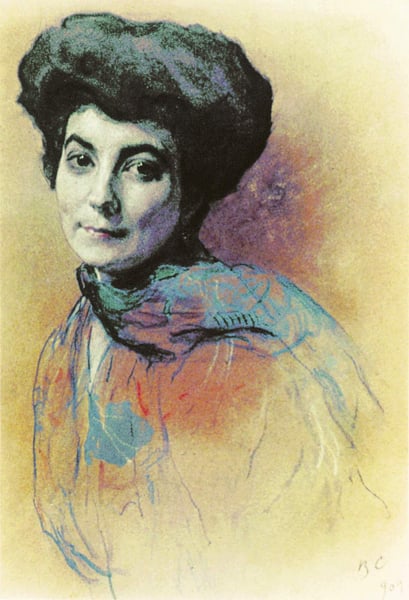
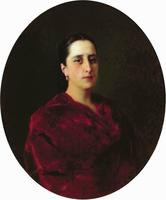
Analisi esperta di Portrait of Helena Ivanovna Roerich di Valentin Serov
Stile: Impressionism · Genere: portrait
As an expert art historian, I will analyze this artwork strictly based on the provided facts: the work is "Portrait of Helena Ivanovna Roerich" by Valentin Serov, executed in the Impressionist style within the portrait genre. Here is the focused analysis of its significance.
Significance within Impressionism and the Portrait Genre:
Valentin Serov stands as a pivotal figure in Russian art, and this portrait exemplifies his masterful synthesis of two often-opposed traditions: the intimate, psychological depth of the Russian realist portrait and the fleeting, atmospheric concerns of French Impressionism.
1. Impressionist Treatment of the Portrait:
While Impressionism traditionally favored landscapes and scenes of modern life over formal portraiture, Serov demonstrated that its core principles—broken color, visible brushwork, and the capture of transient light—could be powerfully applied to the human face and figure. In this work, the "Impressionism" fact indicates that the portrait is not merely a static likeness. Instead, Serov likely used rapid, vibrating strokes to model the sitter's features and drapery, prioritizing the overall optical impression—a momentary glimpse of the subject bathed in ambient light—over meticulous, academic rendering. The significance lies in how he uses these techniques to convey liveliness and an immediate, present-tense quality.
2. Psychological Nuance Within a Loose Style:
The portrait genre typically demands a balance between fidelity to the sitter's character and aesthetic innovation. Serov's significance is his ability to maintain deep psychological insight while employing a seemingly spontaneous, impressionistic vocabulary. In the case of Helena Ivanovna Roerich, the viewer is left with a sense of introspective calm or intellectual presence, achieved not through detailed realism but through the subtle suggestion of posture, gaze, and the handling of light across the plane of the face. This makes the work a landmark of Russian Impressionism: a portrait that feels both modern in its technique and timeless in its humanity.
3. Contextual Breakthrough:
Serov’s adoption of Impressionism, especially in a portrait of a known intellectual figure, was significant within the broader Russian art scene of the late 19th/early 20th century. It challenged the prevailing narrative style of the Wanderers (Peredvizhniki) by proving that a work could be both culturally important (a named individual portrait) and formally radical (Impressionist brushwork). This portrait, therefore, stands as a demonstration that the ephemeral, sensory approach of Impressionism could achieve the gravitas and personal revelation expected of high portraiture.
In summary, the significance of Portrait of Helena Ivanovna Roerich lies in Valentin Serov's successful fusion of Impressionist technique with the classical portrait genre, resulting in a work that is both a vivid optical record and a profound character study, solidifying his role as a leading modernist in Russian art.
Visivamente simili
20 opere con composizione e palette affini
Portrait of Vera Repina
Ilya Repin

Portret Wery Błotnickiej Z Salskich
Leon Wyczółkowski
Portrait SA Lukomskaya
Zinaida Serebriakova
Portrait of Lady Michaelis
John Singer Sargent
Portrait of Sanduht
Martiros Sarian
Spanish Girl
William Merritt Chase
Mulher com Luneta
Columbano Bordalo Pinheiro
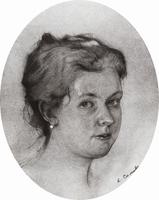
Portrait A. Somova-Mikhailova
Konstantin Somov
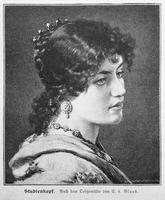
The Garden Arbor
Eugene de Blaas
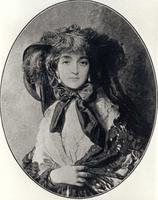
Portrait of Katarzyna Potocka née Branicka, wife of Adam Potocki
Franz Xaver Winterhalter
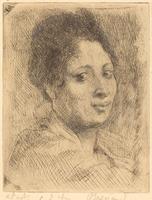
Peppina
Paul-Albert Besnard
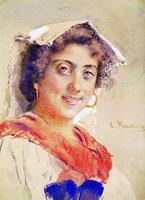
Italian
Konstantin Makovsky
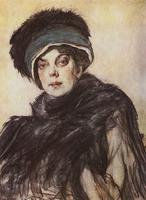
Portrait of a princess Olga Orlova
Valentin Serov
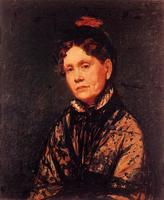
Mrs. Robert Simpson Cassatt
Mary Cassatt
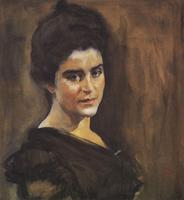
Portrait of Sophia Dragomirova-Lukomskaya
Valentin Serov
Portrait of Sculptor Madeleine Jouvray
Magnus Enckell
Fanny Kemble
Thomas Sully
Portrait of a Woman
Ivan Kramskoy
Woman with a Yellow Bodice
Odilon Redon
Portrait of an Unknown in Red Dress
Konstantin Makovsky