Analisi esperta di Portrait of I.M. Moskvitin di Valentin Serov
Stile: Realism · Genere: sketch and study
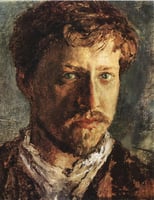
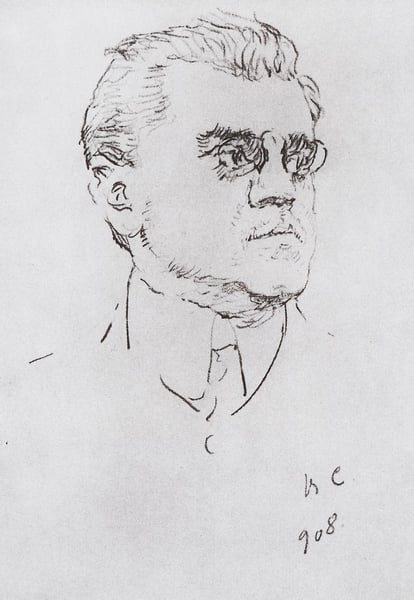
Artwork: Portrait of I.M. Moskvitin
Artist: Valentin Serov
Style: Realism
Genre: Sketch and Study
Expert Analysis
Valentin Serov (1865–1911) is celebrated as one of the foremost portraitists of Russian Realism, known for his ability to capture the psychological interior of his subjects with an almost photographic immediacy—yet rendered through a distinctly painterly hand. This work, a sketch and study titled Portrait of I.M. Moskvitin, offers a rare window into Serov’s creative process and reveals the core principles of his mature style.
Significance Within Realism and as a Sketch/Study
-
Immediacy and Psychological Depth: In the Realist tradition, Serov eschewed idealization in favor of honest, direct observation. As a sketch, this piece is likely executed with speed and economy, focusing on essential features—facial structure, expression, and momentary posture. The genre of “study” indicates that Serov was not producing a finished, polished commission but rather investigating his subject’s character in a raw, unguarded state. Such sketches often convey a vitality and intimacy absent from formal portraits, and this one likely captures Moskvitin’s personality with striking authenticity.
-
Technical Mastery in Minimal Means: Serov’s Realism was not mere replication; it was a disciplined selection of detail. Here, the brushwork (whether in pencil, charcoal, or oil) would be decisive—each stroke serving both descriptive and expressive purposes. The unfinished quality of a study reveals his method: building form through tonal relationships rather than linear outlines, a hallmark of the best Realist portraiture. The significance lies in how Serov achieves a complete impression of the sitter with apparent spontaneity, a skill that set him apart from his contemporaries.
-
Context of Russian Realist Portraiture: By the late 19th century, Russian Realism had moved beyond simple social documentation to embrace psychological complexity (exemplified by the Peredvizhniki movement, with which Serov was connected). This study of I.M. Moskvitin—likely an actor or cultural figure given Serov’s frequent subjects—demonstrates the Realist goal of revealing the inner life through outward appearance. The sketch format itself underscores the artist’s belief that truth is found in the unposed moment, not in laborious idealization.
Conclusion: As a sketch and study, Portrait of I.M. Moskvitin is significant not despite its apparent incompleteness, but because of it. It preserves Serov’s first, most honest response to his sitter—a moment of intense observation that crystallizes the essence of Realist portraiture: the conviction that a few truthful strokes can reveal more than a hundred polished ones. This work stands as a testament to Serov’s ability to fuse technical economy with profound human insight, making it a valuable document of both his artistic process and the enduring power of Realist study.
Genere
Stile
Visivamente simili
20 opere con composizione e palette affini
Portrait of Ivan Moskvin
Boris Kustodiev
Portrait Daniel Henry Kahnweiler
Juan Gris
Portrait of K.B. Kustodiev
Boris Kustodiev
Portrait B.A.Gorin-Goryainov
Boris Kustodiev
Portrait of Konstantin Stanislavski
Valentin Serov
Scheiber Hugó.. . Férfi Portré
Scheiber Hugó
Self-Portrait
Max Liebermann
Portrait of Armand Salacrou
Jean Dubuffet
Self Portrait
Hryhorii Havrylenko
Martiros Sarian
Babken Kolozyan
Portrait of the Novelist Thomas Mann
Max Oppenheimer
A Flemish Intellectual
Luc Tuymans
Man smoking
Thalia Flora-Karavia
Portrait of Konstantin Stanislavski
Valentin Serov
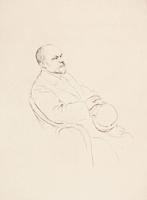
Portrait of Poincaré listening to a speech
Émile Friant
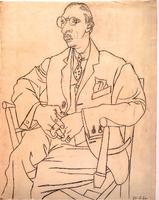
Portrait of Igor Stravinsky
Pablo Picasso
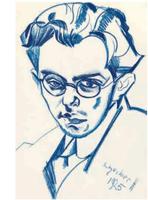
Scheiber Hugó, Fiatal Férfu Hátra Fésült Hajjal 1925
Scheiber Hugó
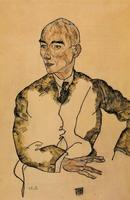
Portrait of Dr. Viktor Ritter von Bauer
Egon Schiele
Czóbel Bela Fiú Portré
Bela Czobel
Portrait of Boris Serebryakov
Zinaida Serebriakova