Expertenanalyse zu Viktor Vasnetsovs Oleg at his horse`s remains
Stil: Romanticism · Genre: literary painting
Expert Analysis of "Oleg at His Horse's Remains" by Viktor Vasnetsov
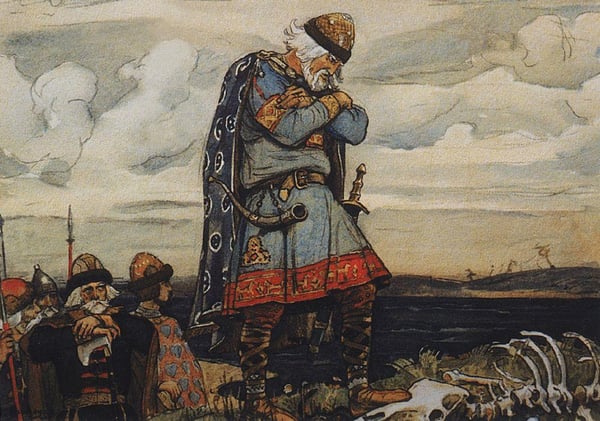
Viktor Vasnetsov's "Oleg at His Horse's Remains" is a powerful example of Romanticism within the literary painting genre, drawing its narrative weight from Russian folklore and medieval history. The work captures a pivotal, somber moment from the legend of Prince Oleg of Novgorod (a figure immortalized in Alexander Pushkin’s ballad "The Song of the Wise Oleg"). According to the prophecy, Oleg was fated to die from his own horse; after years of separation, he returns to find only the animal’s bones, only to be bitten by a snake hidden in the skull—fulfilling the prophecy.
Significance within Romanticism and Literary Painting:
-
Emotional Intensity and Sublime Melancholy: Vasnetsov masterfully conveys the Romantic fascination with profound human emotion—here, the prince’s solemn reflection on fate, mortality, and loss. The brooding sky, the barren landscape, and the stark, skeletal remains of the horse heighten the elegiac mood, emphasizing the Romantic theme of nature’s indifference to human destiny.
-
National Identity and Historical Myth: As a literary painting rooted in Russian epic tradition, the work embodies Romanticism’s drive to revive national folklore and medieval history. Vasnetsov was a key figure in the Russian Romantic movement, and this painting is significant for its role in shaping a visual language for Russia’s legendary past—blending historical costume, symbolic landscape, and narrative clarity to make the old tale accessible and emotionally resonant.
-
Dramatic Contrast and Symbolism: The composition contrasts the living, armored warrior with the decaying bones, a quintessential Romantic juxtaposition of life and death, glory and ruin. The horse’s skull, a memento mori, anchors the painting’s moral: the vanity of earthly pride. This symbolic layering, typical of Romantic literary painting, elevates the work beyond mere illustration into a meditation on the inescapable cycle of fate.
Conclusion:
"Oleg at His Horse’s Remains" stands as a significant achievement within Romanticism for its fusion of historical legend, deep emotional pathos, and nationalistic pride. Vasnetsov transforms a folk tale into a universal allegory of human vulnerability, cementing the painting’s place as a touchstone of Russian Romantic literary art.
Visuell ähnlich
20 Werke mit ähnlicher Komposition und Farbpalette
Calling of Vikings
Viktor Vasnetsov
Oleg`s farewell to his horce
Viktor Vasnetsov
Funeral Feast for Oleg
Viktor Vasnetsov
OSTRUD AND TELRAMUND FROM WAGNER’S LOHENGRIN
Heinrich Lefler
Boyan
Viktor Vasnetsov
Contract Sealed with Blood (Blood Oath)
Bertalan Szekely
Ilya of Murom. Illustration for the book "Russian epic heroes"
Andrei Ryabushkin
Saint Olav at the Battle of Stiklestad
Peter Nicolai Arbo
Monomakh`s hunting
Viktor Vasnetsov
Michael the Brave
Theodor Aman
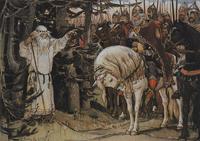
Oleg meets wizard
Viktor Vasnetsov
Confession
Gustave Dore
Yermak with cossacks (Study to "The Conquest of Siberia by Yermak")
Vasily Surikov
Promise
Sergey Solomko
Svyatoslav's meeting with Emperor John, as described by Leo the Deacon
Klavdy Lebedev
Prince Ukhtomsky in the Battle with Tartars at Volga in 1469
Andrei Ryabushkin
Find
Sergey Solomko
Bela
Josef Kriehuber
Hugues De Payens
Henri Lehmann
Hjalmar's Farewell To Orvar Odd After The Battle On Samsö
Mårten Eskil Winge