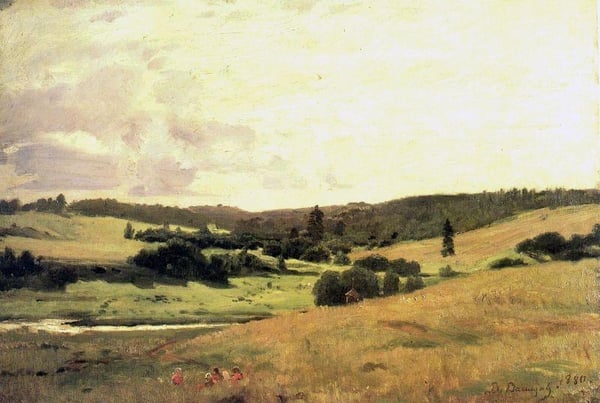
The valley of the river near the village of Vori whorl, landscape with children
Details
Expertenanalyse zu Viktor Vasnetsovs The valley of the river near the village of Vori whorl, landscape with children
Stil: Realism · Genre: landscape
Expert Analysis of "The Valley of the River Near the Village of Vori Whorl, Landscape with Children" by Viktor Vasnetsov
Style/Period: Realism (19th-century Russian Realist tradition)
Significance within Realism and Vasnetsov’s Oeuvre:
This painting occupies a unique place within Viktor Vasnetsov’s career, which is predominantly associated with epic historical and mythological subjects (e.g., Bogatyrs, Alyonushka). Here, Vasnetsov turns to pure landscape and genre, demonstrating his mastery of Realist principles and his deep connection to the Russian countryside. The work is significant for several reasons:
-
Fidelity to Nature and Everyday Life: True to Realist doctrine, Vasnetsov meticulously records the topography of the valley near Vori Whorl, a specific, unidealized locale. The inclusion of children—likely local peasant children—anchors the landscape in the quotidian rhythms of rural existence, elevating a simple, unposed moment into art. This echoes the Realist commitment to depicting ordinary people and their environments without romanticization.
-
Harmony of Human and Natural Elements: Unlike many landscapes of the period that either dominate or subordinate human figures, Vasnetsov integrates the children organically into the scene. They are not allegorical or heroic; they are part of the valley’s life, perhaps playing or tending to chores. This balance reflects the Realist belief that humans are shaped by their environment, and that landscape can be a vehicle for social observation.
-
Technical Realism and Atmospheric Effect: Vasnetsov applies careful observation of light, texture, and atmospheric perspective. The valley’s contours, the river’s course, and the distant village are rendered with topographical precision, while the children introduce subtle narrative potential. The work likely employs a muted, naturalistic palette that captures the specific weather or season of the Russian heartland, avoiding the dramatic chiaroscuro of earlier Romanticism.
-
Art Historical Context: Although Vasnetsov is best known for his later symbolist and folkloric works, this landscape reflects the pivotal influence of the Peredvizhniki (The Wanderers)—the Russian Realist movement that championed truthful, often socially conscious depictions of the people and land. Here, Vasnetsov aligns with their ethos, showing the countryside as a place of quiet, unassuming dignity rather than idealized beauty.
In sum, the painting is significant as a rare Realist excursion by a master of mythic narrative, proving Vasnetsov’s versatility and his intimate understanding of the Russian land and its people. It encapsulates the Realist achievement: finding profound meaning in the ordinary, and weaving human presence into the fabric of nature without sentimentality.
Visuell ähnlich
20 Werke mit ähnlicher Komposition und Farbpalette
Oyat river
Vasily Polenov
Oka near Tarusa
Vasily Polenov
Field
Isaac Levitan
The Istra River
Isaac Levitan
Road
Isaac Levitan
July Afternoon
Edward E. Simmons
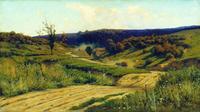
A road
Volodymyr Orlovsky
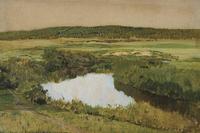
At twilight. River Istra.
Isaac Levitan
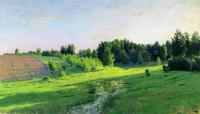
Evening shadows
Isaac Levitan
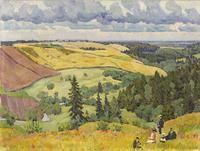
Landscape of Novgorod Governorate
Konstantin Yuon
Landscape - A Shinnecock Vale
William Merritt Chase
Meadow at the forest edge. Siverskaya
Ivan Shishkin
Autumn
Mikhail Nesterov
Пейзаж
Vitold Byalynitsky-Birulya
The Road to Warrandyte
Clara Southern
On Wimbledon Common
Sidney Richard Percy
Voria
Vasily Polenov
River Scene with a Shepherd and Sheep by a Ferry
Alfred Parsons
Misty Morning
Ivan Shishkin
The road to the violet
Sattar Bahlulzade