Analisi esperta di Three princess of the Underground Kingdom di Viktor Vasnetsov
Stile: Romanticism, Symbolism · Genere: mythological painting
Expert Analysis: "Three Princess of the Underground Kingdom" (1884) by Viktor Vasnetsov
Viktor Vasnetsov’s Three Princess of the Underground Kingdom stands as a pivotal work within both Russian Romanticism and Symbolism, embodying the artist’s mission to revive national folklore through monumental, visionary painting. The work merges the Romantic fascination with medieval legend and the Symbolist pursuit of hidden meaning, elevating a simple folk tale into a profound meditation on wealth, power, and spiritual virtue.
Composition and Symbolic Hierarchy
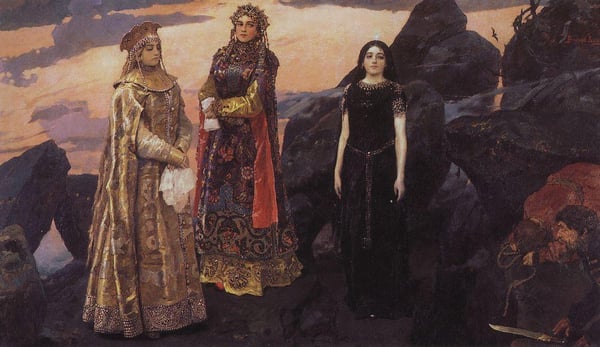
The three princesses—each representing a different subterranean treasure—are arranged in a frieze-like procession across the foreground, their static, iconic poses recalling Byzantine iconography or medieval manuscript illuminations. Vasnetsov contrasts the opulent, detailed costumes of the princesses (gold, jewels, and brocade) with the stark, dark background of the underground cavern, emphasizing their otherworldly nature.
- The Princess of Gold (left), draped in heavy golden brocade and a crown, embodies material wealth. Her direct, almost confrontational gaze and rigid posture suggest pride and the allure of earthly riches.
- The Princess of Precious Stones (center), adorned with emeralds, rubies, and sapphires, represents hidden beauty and natural splendor. Her contemplative expression and slightly turned head introduce a note of melancholy, hinting at the loneliness of beauty buried in darkness.
- The Princess of Coal (right) stands in stark contrast: she wears a simple, dark dress and a shawl, with no jewels. Her bowed head and humble gesture—as if offering a gift—symbolize the humble, unseen labor of miners and the transformative power of human effort. Critics at the time noted this figure as a radical departure from typical fairy-tale princesses, injecting a social conscience into the mythological genre.
Significance within Romanticism and Symbolism
Romanticism: Vasnetsov follows the Romantic tradition of seeking the sublime and the national spirit. By dramatizing a Russian folk story (from the tale of three underground princesses guarding precious minerals), he elevates local folklore to the level of high art, akin to the Brothers Grimm’s work in Germany. The painting’s dark, moody atmosphere and mystical glow from the princesses’ jewels evoke the Romantic sublime—awe mixed with fear of the unknown depths of the earth.
Symbolism: More crucially, the work anticipates Russian Symbolism’s interest in dualities: the visible vs. the invisible, the material vs. the spiritual. The three princesses are not just characters but allegories—of greed (gold), beauty (stones), and humility (coal). Vasnetsov deliberately subverts the expected hierarchy: the most richly dressed princess (Gold) appears the least sympathetic, while the humble Coal Princess commands the viewer’s empathy. This inversion reflects Symbolist tropes of hidden truth and the superiority of inner worth over outward display.
Legacy
Three Princess of the Underground Kingdom was revolutionary for its time. While many painters depicted mythological scenes as classical or academic tableaux, Vasnetsov rooted his in specifically Russian earth and labor. The painting influenced later Symbolist artists like Mikhail Vrubel and the folk-revivalist movement in Russian decorative arts. It remains a key example of how Romanticism’s emotional intensity and Symbolism’s layered meanings could coexist, transforming a fairy tale into a timeless commentary on humanity’s relationship with the earth’s treasures—both literal and metaphorical.
Museum / Gallery
Visivamente simili
20 opere con composizione e palette affini
Three Tsarevnas of the Underground Kingdom
Viktor Vasnetsov

Queen Guinevere
James Archer

Boyar Wedding
Klavdy Lebedev
Clownish coat. Boyar Morozov A. in front of Ivan the Terrible
Mikhail Nesterov
The Captive
Jaroslav Čermák
The Play Scene in Hamlet
Edwin Austin Abbey
Young lady with blue fur coat
Vasily Surikov

Bathory at Pskov
Jan Matejko
Now is the Pilgrim Year Fair Autumn's Charge
Byam Shaw
Yaroslavna's Lament
Vasily Perov
Presentation of a young woman to an old bourgeois
Léo Schnug

Flirting Boyar
Sergey Solomko
Return of Queen Zabel of Armenia
Vardges Sureniants
Ceremony of the Garter
Albert Chevallier Tayler
Meeting
Sergey Solomko
Doña Juana "La loca"
Francisco Pradilla

The First Madness of Ophelia
Dante Gabriel Rossetti
Prince Alexander Nevsky in Gold Horde
Henryk Siemiradzki
Gryfino and Leszek
Jan Matejko
Ellen Terry as Lady Macbeth
John Singer Sargent