Analisi esperta di Afghan di Vasily Vereshchagin
Stile: Realism, Orientalism · Genere: portrait
Expert Analysis: "Afghan" by Vasily Vereshchagin
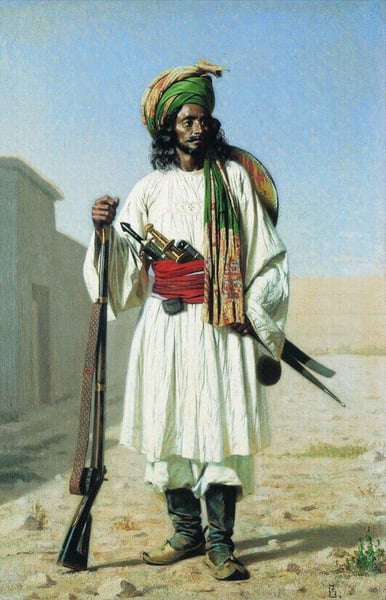
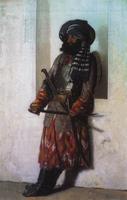
Vasily Vereshchagin’s "Afghan" stands as a compelling intersection of Realism and Orientalism, genres that the artist leveraged to challenge romantic stereotypes while documenting the human face of Russia’s imperial frontier. Painted during or after his extensive travels through Central Asia and Afghanistan, this portrait is significant for its unflinching, ethnographic precision—a hallmark of Vereshchagin’s anti-heroic approach to foreign cultures.
Unlike many Orientalist painters who idealized their subjects through exoticized, soft-focus lenses, Vereshchagin’s Realism strips away fantasy. The depiction of an Afghan individual (likely a warrior, tribesman, or elder) is rendered with the same psychological gravity and meticulous detail he applied to battlefield casualties. The subject’s gaze is direct, dignified, and unapologetic; the treatment of facial features, costume, and texture suggests a deliberate effort to record rather than embellish. This aligns with Vereshchagin’s broader mission: to present non-European peoples as complex individuals, not merely decorative figures.
The work’s significance lies in its subversion of typical 19th-century Orientalist tropes. Where many Western artists portrayed “the Afghan” as a cruel, fanatical “other,” Vereshchagin emphasizes presence and humanity. His Realist grounding insists on the subject’s equality with the viewer—a radical stance given the Russo-Afghan tensions of the era. The portrait thus becomes a quiet political statement, asserting that art can bear witness without condescension.
Within Vereshchagin’s oeuvre, "Afghan" also bridges his famous war series (like The Apotheosis of War) and his ethnographic portfolios. It demonstrates that his realism was not merely about recording horror, but also about honoring the individuality of those caught in imperial crosshairs. For these reasons, the painting remains a key example of how Realism could weaponize the portrait genre to critique Orientalist clichés while advancing the humanist potential of art.
Visivamente simili
20 opere con composizione e palette affini
Hasan Reza Khan, Minister to Asaf al-Daula of Oudh
Johann Zoffany
Rajaputra soldier
Raja Ravi Varma
Portrait of Anagnostopoulos
Theodoros Vryzakis
Arab warrior
Horace Vernet
Afghan
Vasily Vereshchagin
Moorish Guard
Edwin Lord Weeks
Portrait of P. A. Chikhachev
Karl Bryullov
Prayer in the House of an Arnaut Chief
Jean-Leon Gerome
Maharaja Fateh Singh
Raja Ravi Varma
The Count of Palatino in the costume of a Palikar
Richard Parkes Bonington
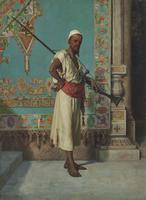
Portrait of an oriental with a gun
Francesco Beda
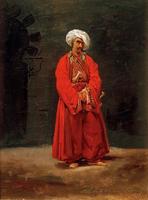
A Man in Oriental Costume
Horace Vernet
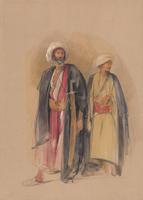
Sheik Hussein of Gebel Tor and His Son
John Frederick Lewis
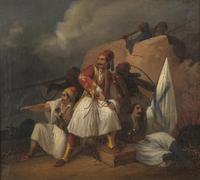
War scene
Theodoros Vryzakis
Edmond O'Donovan as an Oriental
Aloysius O'Kelly
Zeibeck of Smyrna
Charles Gleyre
The Maharaja Dalip Singh
Franz Xaver Winterhalter
Этюд мужчины
Arshak Fetvadjian
Captain John Foote
Joshua Reynolds
Bedouins Preparing for a Raid
Giulio Rosati