Analisi esperta di Elbrus di Vasily Vereshchagin
Stile: Realism · Genere: landscape
Expert Analysis of "Elbrus" by Vasily Vereshchagin
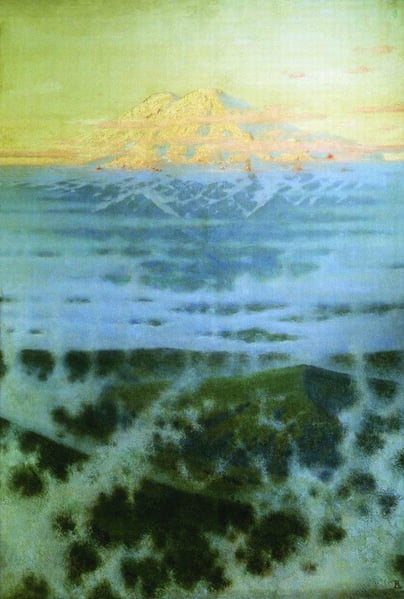
Vasily Vereshchagin is best known for his unflinching war canvases, but "Elbrus" reveals a quieter, yet equally potent, dimension of his Realist practice. Executed during his travels in the Caucasus, this landscape exemplifies how Vereshchagin applied the core tenets of Realism—truth to nature, optical accuracy, and a rejection of idealized formulas—to the sublime wilderness of the Russian Empire.
What makes this work significant:
-
Topographic Fidelity & Atmospheric Realism: Vereshchagin’s "Elbrus" is not a romanticized Alpine vision (as in earlier Barbizon or Romantic painting). Instead, it is a rigorously observed study of light and geology. The artist captures the precise, crystalline clarity of high-altitude air, the subtle gradations of snow and shadow on the twin peaks, and the stark, almost barren foreground. This commitment to empirical observation—recording how the mountain actually looks at a specific time of day under specific weather—was a hallmark of Vereshchagin’s broader Realist method, elevating the landscape from mere backdrop to a subject of scientific and aesthetic truth.
-
Expansion of Russian Realist Subject Matter: While Russian Realists like the Peredvizhniki (The Wanderers) focused on social commentary, peasant life, or the melancholic Russian plains, Vereshchagin brought a global and ethnographic scope to Realism. "Elbrus" embodies his fascination with the imperial frontier—the Caucasus region. By portraying the highest peak in Europe as a formidable, detached natural monument, rather than a picturesque attraction, he challenged Russian viewers to see their own empire’s geography as a site of raw, untamed majesty. The work thus expands the thematic range of 19th-century Realism beyond the purely social into the domain of the natural sublime—but with a documentary, non-sentimental eye.
-
Counterpoint to His War Imagery: Significance also lies in contrast. Vereshchagin’s reputation rests on horrific battle scenes (e.g., The Apotheosis of War). "Elbrus" demonstrates the same relentless honesty applied to peaceful grandeur. Here, the only "drama" is the monumental stillness of the mountain itself. This duality—the ability to depict both war’s carnage and nature’s serenity with equal conviction—marks Vereshchagin as a Realist who refused to limit his gaze. "Elbrus" stands as evidence that for him, realism was not a genre but a philosophical stance: to see clearly, whether in a battlefield or a snowfield.
In essence, "Elbrus" is significant for proving that Vereshchagin’s Realism was not confined to human conflict. It is a masterclass in topographic truth and a key work in the 19th-century Russian tradition of depicting the Caucasus as a place of both physical peril and aesthetic revelation.
Visivamente simili
20 opere con composizione e palette affini
Sat-Mount (Mount Elbrus)
Mykola Yaroshenko
Snow tops
Arkhyp Kuindzhi
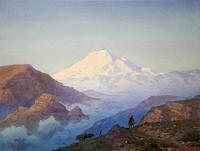
Rider at the Top of the Mountain
Luigi Premazzi
Elbrus
Arkhyp Kuindzhi
Elbrus in the Evening
Arkhyp Kuindzhi
Landscape
Oleg Holosiy
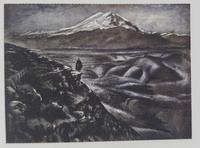
Elbrus
Oleg Holosiy
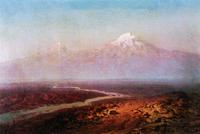
Araks River and Ararat
Ivan Aivazovsky
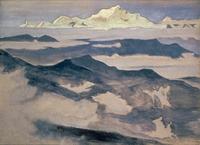
Evening
Nicholas Roerich
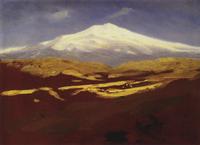
Elbrus in the daytime
Arkhyp Kuindzhi
Fog in the mountains. Caucasus
Arkhyp Kuindzhi
Himalayas
Nicholas Roerich
Border of Tibet
Nicholas Roerich
Kazbek
Arkhyp Kuindzhi
Castles of King Gesar
Nicholas Roerich
Mount McKinley
Sydney Laurence
Mount McKinley in Mist
Sydney Laurence
White and Celestial
Nicholas Roerich
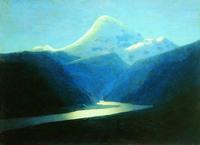
Elbrus in the Evening
Arkhyp Kuindzhi
Mount St. Helens, Columbia River, Oregon
Albert Bierstadt