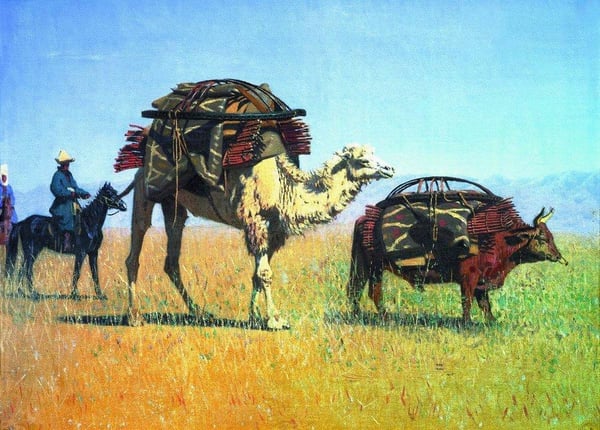
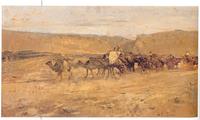
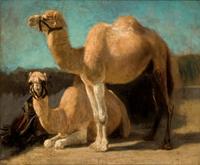
Vasily Vereshchagin’s Migrations Kirghiz (circa 1870s) stands as a pivotal work within the intersection of Realism and Orientalism, distinguished by its unflinching ethnographic precision. Unlike many Western Orientalist painters who romanticized or exoticized nomadic life, Vereshchagin—a Russian artist who traveled extensively through Central Asia—applied a rigorous Realist approach to a genre scene of Kyrgyz migration. The painting’s significance lies in its dual role: it documents the harsh realities of steppe existence (including the stark landscape, the physical strain on animals and people, and the sprawling, dust-laden procession) while also challenging contemporary stereotypes. By foregrounding the everyday grit of migration over picturesque fantasy, Vereshchagin elevates a genre scene into a serious study of cultural identity and survival, breaking with the decorative tendencies of earlier Orientalist works. His technical mastery—subtle tonal shifts for the vast sky, meticulous detail in textiles and yurts—reinforces the work’s authority as a visual record, making it an early landmark of ethnographic realism.