
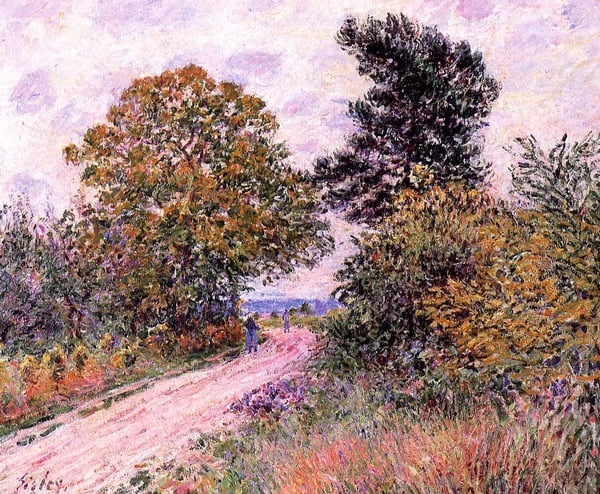
Expert analysis of Alfred Sisley’s Edge of the Fountainbleau Forest Morning
Style: Impressionism · Genre: landscape
Analysis of "Edge of the Fountainbleau Forest Morning" by Alfred Sisley
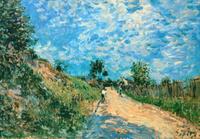
Alfred Sisley’s Edge of the Fountainbleau Forest Morning stands as a quintessential example of Impressionist landscape painting, demonstrating the movement’s core commitment to capturing transient atmospheric effects and the fleeting qualities of natural light. As an Impressionist work, the painting prioritizes sensory immediacy over precise topographical detail, using broken brushwork and a bright, often unmixed palette to convey the freshness of a particular moment—here, the early morning at the edge of the forest.
The significance of this piece lies in Sisley’s dedication to the en plein air method, which allowed him to record the subtle shift of light as dawn breaks over the forest fringe. The “morning” setting is crucial: the low-angle sunlight, soft mists, and cool shadows typical of that time of day are rendered through delicate tonal variations and a restrained, luminous color scheme. Unlike his contemporaries who often focused on urban or coastal scenes, Sisley was a devoted painter of rural landscapes, and this work exemplifies his ability to find poetry in the ordinary—the meeting of open field and woodland edge.
Within the Impressionist movement, Sisley is sometimes overshadowed by Monet or Renoir, but Edge of the Fountainbleau Forest Morning highlights his unique sensibility: a calm, meditative observation of nature’s rhythms. The composition likely leads the eye from the foreground’s cooler, shadowed area into the warmer, sunlit distance, capturing that moment when the forest begins to emerge from the night’s hush. The lack of dramatic anecdote or human figures focuses attention entirely on the atmospheric interplay of light, air, and foliage—the true subject of Impressionist landscape painting. In this way, the work embodies the movement’s radical shift away from narrative and toward pure visual experience.
Visually similar
20 works with related composition and palette
Edge of Fountainbleau Forest June Morning
Alfred Sisley
An August Afternoon near Veneux
Alfred Sisley
Wanderer near the Wood
Camille Pissarro
Untitled
Gustave Loiseau
Landscape The Banks of the Loing at Saint Mammes
Alfred Sisley
Walnut trees at sunset in early October
Alfred Sisley
Path near Sevres
Alfred Sisley
Poppy Field, Argenteuil
Claude Monet
Small Meadows in Spring
Alfred Sisley
The Riverbank at Petit-Gennevilliers
Claude Monet
Landscape with a Man Digging
Camille Pissarro
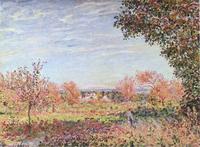
September Morning
Alfred Sisley
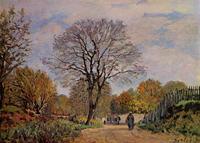
A Road in Seine et Marne
Alfred Sisley
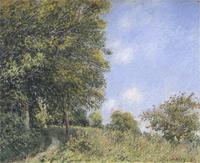
July Afternoon near the Forest
Alfred Sisley
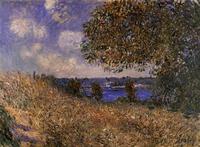
Near the Bank of the Seine at By
Alfred Sisley
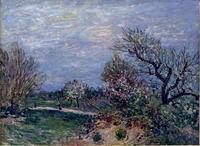
Border of the Woods
Alfred Sisley
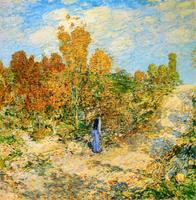
New England Road
Childe Hassam
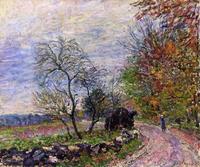
Along the woods in Autumn
Alfred Sisley
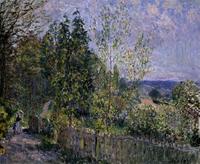
The Road in the Woods
Alfred Sisley
Hill Path
Alfred Sisley