
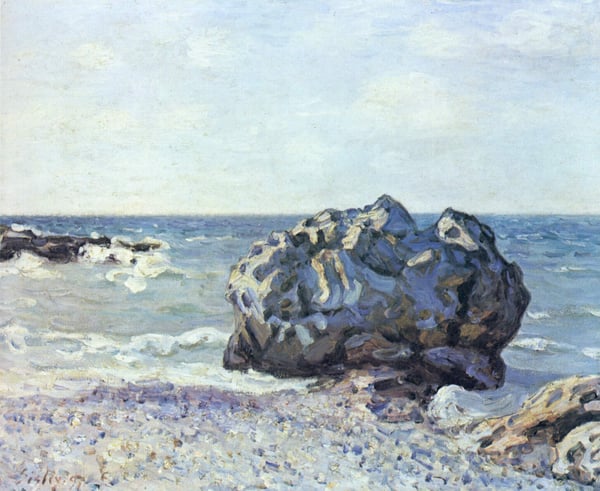
Analyse experte de The Washerwomen of Moret de Alfred Sisley
Style : Impressionism · Genre : landscape
Alfred Sisley’s The Washerwomen of Moret (c. 1890) stands as a quintessential example of Impressionist landscape painting, capturing the fleeting effects of light and atmosphere that define the movement. Sisley, a dedicated Impressionist who focused almost exclusively on landscapes, here merges the genre with a subtle human narrative: the washerwomen at work along the riverbank near the village of Moret-sur-Loing.
Significance within Impressionism:
-
Treatment of Light and Color: Sisley employs a luminous palette of soft blues, silvery greens, and pale pinks to render the shimmering surface of the water and the hazy sky. Broken brushwork typical of Impressionism is used to suggest the dappled reflections of trees and figures, making the atmosphere itself the true subject. The washerwomen’s white clothing catches the sunlight, creating points of brightness that anchor the composition.
-
Everyday Life as a Motif: Unlike the grand historical or mythological subjects favored by the Academy, Sisley elevates a mundane rural chore—women washing clothes—into a scene of lyrical beauty. This aligns with the Impressionist goal of depicting modern life and its ordinary rituals, observed en plein air.
-
Composition and Space: The painting balances a foreground of grassy bank and kneeling figures with a mid-ground of river and reflections, while the distant village buildings and sky recede into soft focus. This spatial layering, combined with the diagonal flow of the river, draws the viewer’s eye through the scene, emphasizing the harmony between human activity and the natural environment.
-
Sisley’s Distinctive Contribution: While Monet and Renoir often focused on more dramatic or sociable subjects, Sisley consistently returned to calm, rural landscapes. The Washerwomen of Moret exemplifies his quieter sensibility, where light and water become a unified, almost poetic field of sensation. His ability to capture the transient quality of a specific moment—the way sunlight plays on moving water and simple cotton fabrics—makes this work a masterful synthesis of Impressionist technique and sincere observation.
Visuellement similaire
20 œuvres à la composition et à la palette proches
Langland Bay, Storr s Rock, Morning
Alfred Sisley
Rocks and sea
Paul Gauguin
Belle-Ile-en-Mer
Maxime Maufra
Near Saint Malo
Henri Martin
Surf, Appledore
Childe Hassam
The Rocks
Theo van Rysselberghe
ROCKS AND SURF
Nathaniel Hone the Younger
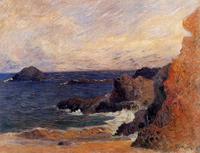
Coastal landscape
Paul Gauguin
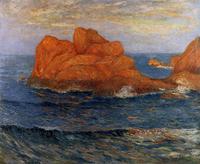
The Red Rocks at Belle Ile
Maxime Maufra
Evening
Victor Puzyrkov
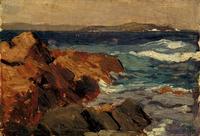
Near Louisbourg, Cape Breton, N.S.
William Brymner
Port-Bara (Near the Ile de Quiberon)
Maxime Maufra
Surf, Isles of Shoals
Childe Hassam
Rocks in Sestri Levante
Vincenzo Cabianca
Antibes, the Point of the Islet
Eugene Boudin
Recifs
Henri Martin
Sea at Ibiza
Joaquín Sorolla
The Coast of Bellangenay
Paul Gauguin
The Barges Lighthouse
Maxime Maufra
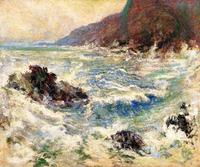
Sea Scene
John Henry Twachtman