Analyse experte de Evening in Moret, End of October de Alfred Sisley
Style : Impressionism · Genre : landscape
Expert Analysis of "Evening in Moret, End of October" by Alfred Sisley
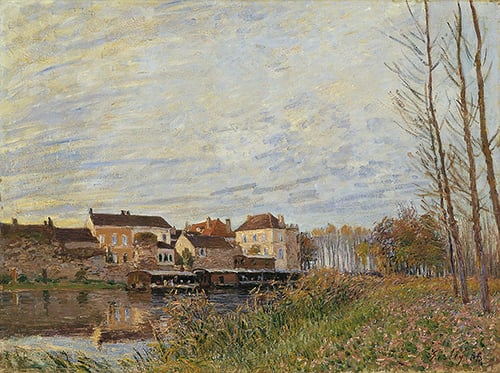
Alfred Sisley’s Evening in Moret, End of October stands as a quintessential example of Impressionist landscape painting, distinguished by its masterful capture of transient atmospheric conditions and the subtle emotional resonance of a specific season. Painted during Sisley’s later years when he had settled in the village of Moret-sur-Loing, this work reflects his unwavering dedication to plein air observation and his unique ability to translate the quiet poetry of nature onto canvas.
Significance within Impressionism:
Sisley is often considered the most consistent and pure of the Impressionists, rarely straying from the genre of landscape. Unlike Monet’s bold experiments or Renoir’s figural works, Sisley’s focus remained on the lyrical interplay of light, water, and sky. Here, the “end of October” is not merely a date but a sensory experience: the low, golden light of evening suffuses the sky with pale yellows and muted lavenders, while the thinning foliage of autumn trees is rendered in a restrained palette of ochres, russets, and soft greens. The painting’s significance lies in its ability to convey a fleeting moment—the chill of dusk creeping over the small French town—without sentimentality or drama, but with an almost meditative calm.
Technical and Stylistic Hallmarks:
Sisley employs broken, feathery brushstrokes typical of Impressionism, yet his touch is notably delicate and refined. The composition is balanced between the solid architecture of Moret’s church tower and the softer curves of the riverbank, demonstrating his sensitivity to structure even amidst atmospheric dissolution. The reflections in the water are rendered with a harmonic looseness that blurs the line between substance and reflection, a hallmark of his best works. This painting exemplifies how Sisley—unlike his peers—often favored muted tonal harmonies over vibrant high-key colors, creating a sense of intimacy and stillness that feels deeply personal.
Why It Matters:
Evening in Moret, End of October is significant as a testament to Sisley’s lifelong commitment to expressing the subtle beauty of the French countryside, particularly the Loing River region. It captures a specific season and time of day with such precise optical truth that it transcends mere documentation to become an exploration of memory and mood. In the broader canon of Impressionism, this work reminds us that the movement’s radicalism lay not in spectacle, but in the quiet revolution of seeing—and feeling—the world as it changes in an instant.
Museum / Gallery
Visuellement similaire
20 œuvres à la composition et à la palette proches
Indian Summer at Moret Sunday Afternoon
Alfred Sisley
The Loing at Moret
Gustave Loiseau
Moret Sur Loing
Alfred Sisley
Banks of the Loing at Moret, Morning
Alfred Sisley
Construction Site at Matrat, Moret sur Loing
Alfred Sisley
By the Oise at Parmain
Gustave Loiseau
Le réservoir à Poitiers
Armand Guillaumin
The Loing at Saint Mammes
Alfred Sisley
Barges on the Loing, Saint Mammes
Alfred Sisley
Flood in Pontoise
Camille Pissarro
Moret Sur Loing
Alfred Sisley
Argenteuil, The Seine
Claude Monet
View of Saint Mammes
Alfred Sisley
Banks of the Loing near Moret
Alfred Sisley
May Afternoon on the Loing
Alfred Sisley
Pontoise banks of the Oise
Camille Pissarro
Matratat s Boatyard, Moret sur Loing
Alfred Sisley
The Loing at Moret, the Laundry Boat
Alfred Sisley
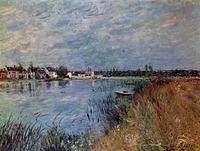
Riverbank at Saint Mammes
Alfred Sisley
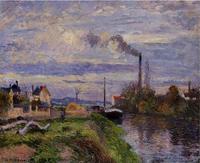
Quai du Pothuis, at Pontoise
Camille Pissarro