
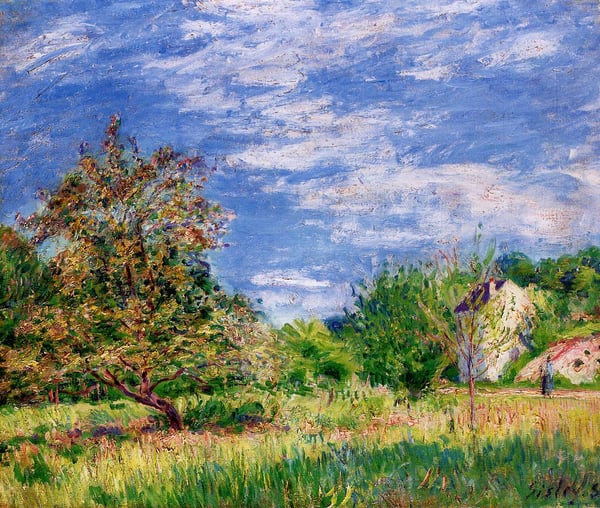
Expertenanalyse zu Alfred Sisleys Orchard in Spring
Stil: Impressionism · Genre: landscape
Expert Analysis of "Orchard in Spring" by Alfred Sisley
Alfred Sisley’s Orchard in Spring stands as a quintessential example of Impressionist landscape painting, embodying the movement’s core pursuit of capturing fleeting atmospheric effects and the play of natural light. As a dedicated landscapist, Sisley was less interested in human figures or narrative than in the transient beauty of rural scenes, and this work showcases his unique sensitivity to the subtleties of spring.
Significance within Impressionism
-
Mastery of Light and Atmosphere: Sisley’s handling of light is neither dramatic nor harsh but soft and diffused, characteristic of early spring’s hazy sunlight. He builds the scene with broken, feathery brushstrokes that flicker across the canvas—a hallmark of Impressionist technique—allowing the eye to blend colors optically rather than through smooth blending. The white and pink blossoms of the orchard are rendered not as solid forms but as dabs of pure pigment, shimmering against a sky of pale blues and pearly grays.
-
Plein Air Intimacy: Painted outdoors (en plein air), Orchard in Spring captures a specific moment—perhaps mid-morning when dew still glistens and shadows are short. Sisley’s composition is deceptively simple: a row of flowering trees recedes diagonally into the distance, leading the eye toward a low horizon. This uncluttered arrangement emphasizes the rhythm of nature and the quiet lull of the season.
-
Color Harmony and Delicacy: Unlike some Impressionists who favored saturated, high-key palettes, Sisley’s Orchard in Spring relies on a restrained harmony of pastel tones—soft greens, pinks, lilacs, and muted earth. This subtlety is where his genius lies: he avoids the obvious appeal of vibrant color, instead conjuring the gentle whisper of spring through nuanced modulations. The result is a painting that feels both fresh and contemplative.
Why It Matters
-
Sisley’s Purity of Vision: Among the Impressionists, Sisley remained the most devoted to landscape for its own sake, never straying into figure painting or urban subjects. Orchard in Spring exemplifies his lifelong commitment to capturing the atmospheric conditions of the French countryside—especially the Île-de-France region, where orchards and rivers were his primary motifs.
-
Contribution to the Impressionist Aesthetic: While Monet’s gardens and Renoir’s fêtes dominate popular memory, Sisley’s orchards and riverscapes are the quiet champions of the movement. Orchard in Spring illustrates how Impressionism could be both immediate (the flicker of light on blossoms) and deeply lyrical (the eternal cycle of blooming). It is a work that rewards patient looking—each brushstroke a note in a soft, spring melody.
Visuell ähnlich
20 Werke mit ähnlicher Komposition und Farbpalette
Edge of Fountainbleau Forest June Morning
Alfred Sisley
Springtime
Claude Monet
September Morning
Alfred Sisley
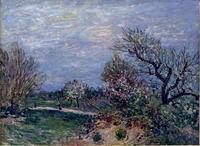
Border of the Woods
Alfred Sisley
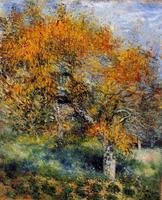
The Pear Tree
Pierre-Auguste Renoir
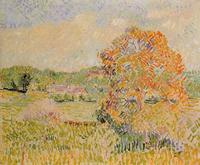
Springtime at Eragny (study)
Camille Pissarro
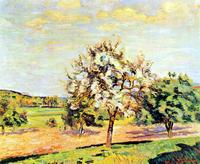
Pommiers en fleurs
Armand Guillaumin
Belkino. Garden.
Pyotr Konchalovsky
Untitled
Gustave Loiseau
Walnut Trees, Sunset Early Days of October
Alfred Sisley
Springtime
Claude Monet
Cagnes Landscape
Pierre-Auguste Renoir
Meadow
Claude Monet
An Apple Tree at Eragny
Camille Pissarro
The Plain of Veneux, View of Sablons
Alfred Sisley
Young corn
Charles-Francois Daubigny
Orchard
Richard Gerstl
An Autumn Evening near Paris
Alfred Sisley
Autumn Landscape
Robert Lewis Reid
Windy Day At Veneux
Alfred Sisley