
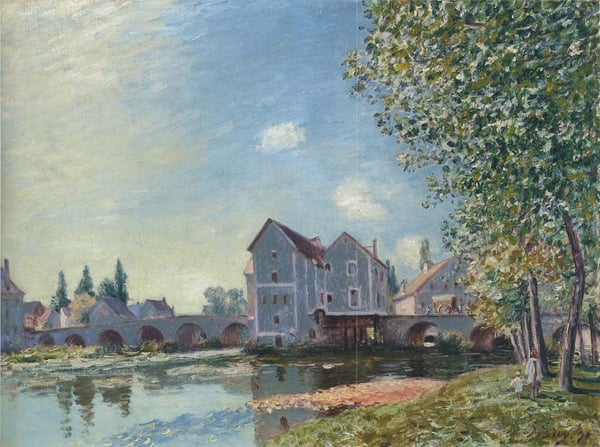
Analisi esperta di The Pont at Moret Afternoon effect di Alfred Sisley
Stile: Impressionism · Genere: landscape
Expert Analysis: "The Pont at Moret Afternoon effect" by Alfred Sisley
Style & Context:
As a pure Impressionist landscape, this work exemplifies Sisley’s unwavering dedication to capturing the transient effects of light and atmosphere. Painted in the late 1880s, it belongs to a series of views of the medieval bridge and town of Moret-sur-Loing, a subject Sisley revisited obsessively—much like Monet with his haystacks or Rouen Cathedral. The title itself announces the specific temporal focus: afternoon effect, signaling the artist’s primary concern with how daylight at a particular hour transforms color, shadow, and reflection.
Significance within Impressionism:
While Sisley never achieved the fame of Monet or Renoir, he is often considered the most consistent and “pure” Impressionist—never straying into the figure painting or experimental symbolism of his peers. This work demonstrates his mastery of two core Impressionist tenets: plein-air spontaneity and broken brushwork. The bridge arches are rendered with short, feathery strokes of pale stone, grey-blue, and ochre, dissolving solid form into shimmering vibration. The water’s surface is a mosaic of sapphire, turquoise, and soft violet, reflecting the sky while simultaneously recording the ripple of the current.
Light and Atmosphere:
The “afternoon effect” here is subtle but decisive. Unlike Monet’s dramatic contrasts, Sisley favors a gentle, pearlescent light that washes over the scene. The shadows under the bridge are not black but a deep, cool mauve—a hallmark of Impressionist color theory. The sky is a pale, crystalline blue with wispy, horizontal clouds, suggesting a warm but slightly hazy day. The foliage along the riverbank is rendered in soft yellows and greens, lacking strong outlines, as if seen through a veil of luminous air.
Composition and Mood:
The composition is classically balanced: the stone bridge spans the canvas diagonally, guiding the eye from lower left to upper right, while the reflection anchors the lower half. Yet there is no grand narrative—only the quiet poetry of everyday landscape. Sisley’s genius lies in making the ordinary (a bridge, a river, a village) feel intimate and eternal. The painting’s significance lies not in innovation of subject but in its refined sensitivity to mood—a hushed, contemplative atmosphere that feels still yet alive with the pulse of light.
Legacy:
“The Pont at Moret Afternoon effect” is a definitive example of Sisley’s late-career focus on seriality and the nuanced study of a single motif. It stands as a testament to his belief that the most profound beauty exists in the fleeting, unheroic moments of nature—a core value of Impressionism that this work captures with quiet, luminous authority.
Visivamente simili
20 opere con composizione e palette affini
The Loing Flowing under the Moret Bridge
Alfred Sisley
Sunset at Moret
Alfred Sisley
Moret on Long Time Gray
Alfred Sisley
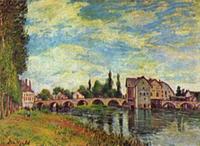
Pont et Moulin de Moret en été
Alfred Sisley
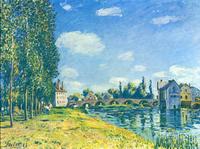
The straw Rent
Alfred Sisley
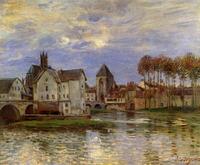
The Moret Bridge at Sunset
Alfred Sisley
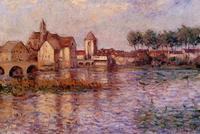
Moret sur Loing
Alfred Sisley

The Bridge at Moret
Alfred Sisley
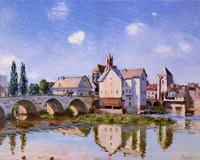
The Moret Bridge in the Sunlight
Alfred Sisley
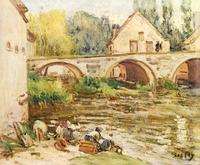
The Washerwomen of Moret
Alfred Sisley
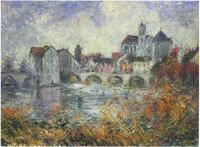
Moret on Loing Autumn
Gustave Loiseau
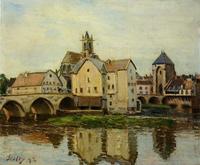
Moret sur Loing, Morning
Alfred Sisley
Moret sur Loing the Porte de Bourgogne
Alfred Sisley
Pont de Moret sur Loing
Alfred Sisley
Moret sur Loing
Alfred Sisley
The Bridge at Moret at Sunset
Alfred Sisley
The Moret Bridge
Camille Pissarro
View of Moret sur Loing through the Trees
Alfred Sisley
The Bridge and Mills of Moret, Winter s Effect
Alfred Sisley
The Moret Bridge and Mills under Snow
Alfred Sisley