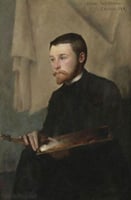
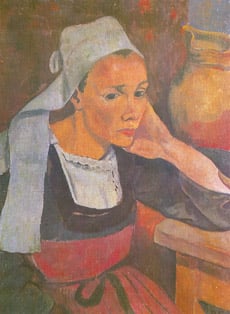
Expertenanalyse zu Paul Serusiers Portrait of Marie Lagadu
Stil: Post-Impressionism · Genre: portrait
Expert Analysis of "Portrait of Marie Lagadu" by Paul Sérusier
Style & Period Context
Paul Sérusier (1864–1927) was a pivotal figure within Post-Impressionism and a founding member of the Nabi movement. His work represents a decisive shift from naturalism toward symbolic, subjective expression—a hallmark of Post-Impressionism’s broader rejection of optical realism. In this portrait, Sérusier applies principles he absorbed from Paul Gauguin at Pont-Aven in 1888: the use of flat, unmodulated color patches, emphatic outlines, and a deliberate flattening of pictorial space. The painting likely embodies Synthetism—a style that synthesizes the artist’s memory and emotion with simplified forms, rather than copying nature directly.
Significance as a Portrait
Unlike conventional portraits that aim for likeness or psychological depth through modeling and chiaroscuro, Sérusier’s “Portrait of Marie Lagadu” prioritizes decorative harmony and symbolic resonance. The sitter—likely a Breton or rural figure—is not individualized in a naturalistic sense but becomes a vehicle for the artist’s internal vision. The strong, rhythmic contours and jewel-like color planes reflect the Nabi credo that a painting should be “a flat surface covered with colors assembled in a certain order.” This approach democratizes portraiture, shifting focus from the subject’s social status to the painter’s interpretive gesture.
Art-Historical Importance
This work is significant as an early example of how Post-Impressionist portraiture broke from academic conventions. Sérusier’s influence extended to fellow Nabis such as Pierre Bonnard and Édouard Vuillard, who pursued similar decorative simplifications. The portrait also foreshadows modernist concerns with abstraction: by reducing form to essential shapes and using color arbitrarily (rather than descriptively), Sérusier paved the way for Fauvism and Expressionism.
Conclusion
“Portrait of Marie Lagadu” is not merely a likeness but a manifesto of Post-Impressionist and Nabi ideals. Its significance lies in its radical synthesis of Gauguin’s symbolism, cloisonnist linework, and a personally charged palette—making it a key document in the transition from 19th-century naturalism to 20th-century modernism.
Visuell ähnlich
20 Werke mit ähnlicher Komposition und Farbpalette
Mädchen Ölstudie
Paul Hoecker (Höcker)
Breton
Zinaida Serebriakova
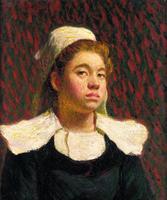
Bretonne
Roderic O'Conor
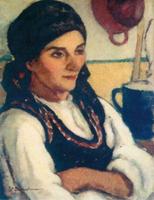
The Cook
Stefan Dimitrescu
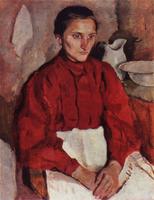
Portrait of a nurse
Zinaida Serebriakova
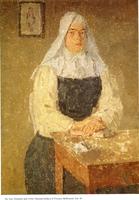
Marie Poussepin Seated at a Table
Gwen John
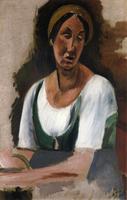
Bust of a Woman
Andre Derain
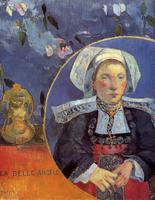
The Beautiful Angel (Madame Angele Satre, the Innkeeper at Pont-Aven)
Paul Gauguin
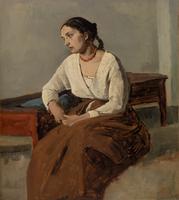
Melancholy Italian Woman (Rome)
Camille Corot
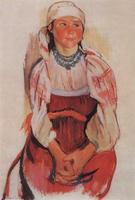
Moloduha (Maria Zhegulina)
Zinaida Serebriakova
Poor Childhood
Constantin Artachino
Peasant Woman Peeling Potatoes
Vincent van Gogh
Gipsy Woman in the Veranda
Nicolae Vermont
Thinking
Nicolae Vermont
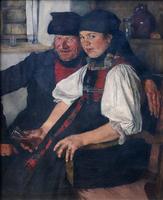
Dag ungleiche Pahr
Wilhelm Leibl
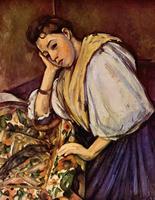
Young Italian Girl Resting on Her Elbow
Paul Cezanne
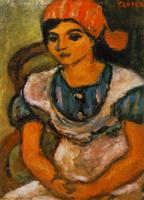
Girl with Red Shawl
Bela Czobel
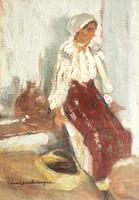
Peasant Woman on Bench
Rudolf Schweitzer-Cumpana
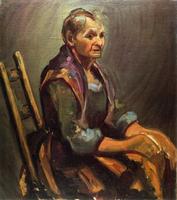
Old Woman
George Luks
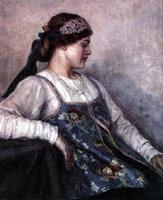
Portrait of Natalia F. Matveeva
Vasily Surikov