J.M.W. Turner の Bonneville, Savoy with Mont Blanc の専門的な分析
スタイル:Romanticism · ジャンル:landscape
This analysis focuses on the significance of J.M.W. Turner's Bonneville, Savoy with Mont Blanc within the context of Romanticism and landscape painting.
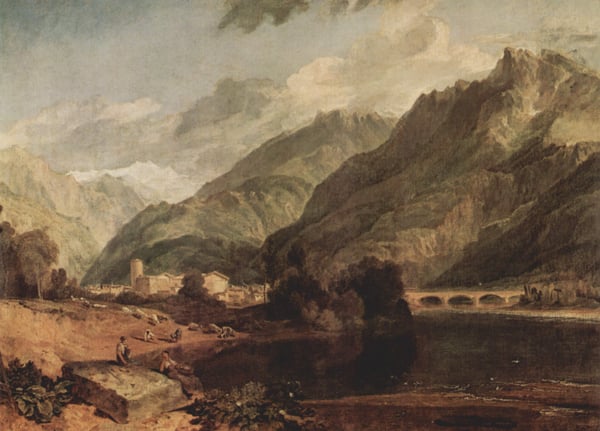
Turner’s Bonneville, Savoy with Mont Blanc is a quintessential Romantic landscape that exemplifies the artist’s revolutionary approach to nature and atmosphere. The painting captures the village of Bonneville in the French Alps, dominated by the towering, distant peak of Mont Blanc. Its significance lies in how Turner transforms a topographical scene into a sublime experience, prioritizing emotional and sensory impact over precise documentation.
Sublime Nature and Human Insignificance: A core theme of Romanticism is the sublime—nature’s overwhelming power and beauty that dwarfs human presence. Turner achieves this by placing the massive, snow-capped Mont Blanc at the composition’s apex, its scale exaggerated by atmospheric haze. Below, the village and figures in the foreground appear tiny and fragile, reinforcing humanity’s subordinate role within the vast, untamed landscape. The viewer is invited to feel awe, even a touch of terror, at nature’s majesty.
Revolutionary Use of Light and Atmosphere: Turner was a master of capturing transient effects of light, weather, and atmosphere. In this painting, he dissolves hard outlines and blends sky, mountains, and valley into a luminous, almost ethereal whole. The warm golden light of the setting or rising sun contrasts with the cool blues and whites of the glacier, creating a dramatic interplay. This technique—often called “Turnerian” or “picturesque atmosphere”—was groundbreaking. It moves landscape painting away from mere representation toward expressing nature’s emotional and spiritual resonance.
Transition from Topography to Poetry: While Bonneville is a recognizable location, Turner deliberately exaggerates the verticality of the mountains and the misty distance to evoke a sense of the infinite. This marks a departure from earlier, more topographically accurate landscape traditions. Instead, Turner imbues the scene with dramatic, almost visionary qualities, making the viewer feel the raw energy of the Alpine environment. The painting thus stands as a landmark in the Romantic movement, showing how landscape could convey profound emotional and philosophical ideas. It is a testament to Turner’s belief that nature, especially in its most formidable forms, is the ultimate subject for art—both beautiful and terrifying, eternal and fleeting.
視覚的に類似
構図やパレットが近い作品 20 件
View of Fortundalen
Johan Christian Dahl
View in the Valley of Oberhasle, Switzerland
Asher Brown Durand
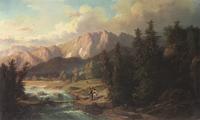
View of the Tatras
Alfred Schouppé
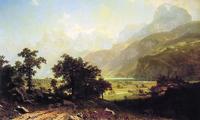
Lake Lucerne, Switzerland
Albert Bierstadt
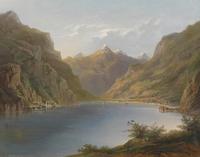
Vierwaldstättersee Mit Blick Auf Die Tellkapelle
Hermann Ottomar Herzog
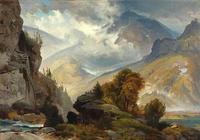
The White Mountains
Thomas Moran
Der Glärnisch im Abendlicht
Johann Gottfried Steffan
The Jungfrau, Switzerland
Alexandre Calame
At the Lake of Uri
Alexandre Calame
Peace at Sunset (Evening in the White Mountains)
Thomas Cole
Lac Leman
Alexandre Calame
Bernese Alps, as Seen near Kusmach
Albert Bierstadt
Fishing Party in the Mountains
Thomas Hill
Ben Vorlich
David Cox
Das Lauterbrunner Tal
Joseph Anton Koch
Blick auf den Vierwaldstättersee mit Schillerstein und den verschneiten Bristen
Adolf Mosengel
Arthur's Pass, Otira Gorge
Isaac Whitehead
Mountain landscape with stream between rocks
Ludwig Richter
Paesaggio montuoso con donna e bimbo
Giulio Lange
View on the Androscoggin River, Maine
David Johnson