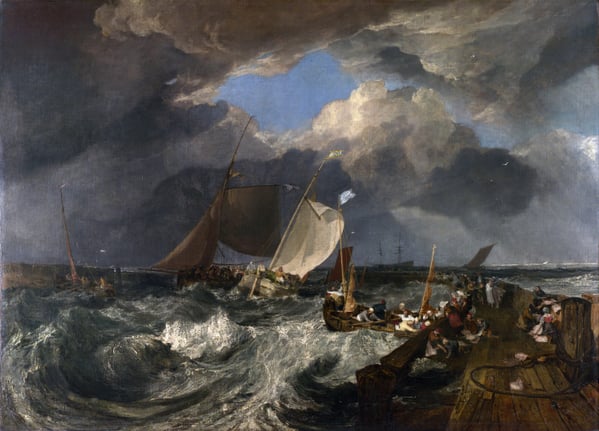
Calais Pier, with French Poissards Preparing for Sea, an English Packeet Arriving
Détails
Analyse experte de Calais Pier, with French Poissards Preparing for Sea, an English Packeet Arriving de J.M.W. Turner
Style : Romanticism · Genre : marina
Expert Analysis: "Calais Pier, with French Poissards Preparing for Sea, an English Packet Arriving" by J.M.W. Turner (1803)
As a defining work of British Romanticism and a masterful marine piece, Turner’s Calais Pier stands as a bold declaration of the artist’s ambition to elevate landscape and seascape painting to the emotional and psychological depth of history painting. Painted when Turner was just 28, the work announces his lifelong obsession with the sublime forces of nature—wind, water, light—and their impact on human endeavor.
Significance within Romanticism:
The painting embodies the Romantic fascination with the sublime—the overwhelming, awe-inspiring, and even terrifying power of the natural world. Turner does not present a calm, orderly harbor; instead, he thrusts the viewer into a chaotic, stormy scene where a small French fishing boat (the poissards preparing for sea) and an arriving English packet boat are dwarfed by heaving waves, scudding clouds, and a dramatic shaft of sunlight breaking through the tempest. The sky churns with a nearly palpable energy, while the sea’s turbulent greens and whites convey both danger and vitality. This is nature as an active, almost sentient force—a hallmark of Romanticism’s rejection of the serene, rational landscapes of the 18th century.
Genre and Technical Innovation:
Though categorized as a marina (a seascape with ships), Turner transforms the conventional harbor view into a dynamic study of atmospheric effects. The composition is deliberately asymmetrical: the pier juts diagonally into the picture, leading the eye into a vortex of weather and activity. Turner’s brushwork is already looser and more expressive than his contemporaries, with broken touches of paint that prefigure his later, near-abstract handling. The light is not a steady illumination but a fleeting, dramatic burst that momentarily reveals the struggle of the boats and figures before the next squall. This treatment of light and atmosphere—especially the contrast between the dark, rain-lashed sky and the glowing patch of sky on the horizon—was revolutionary.
Narrative and Personal Experience:
The painting is famously autobiographical. Turner had just returned from a stormy crossing from Calais to Dover, during which he was lashed to a mast to observe the sea firsthand. This visceral experience infuses the work with authentic tension. The “English packet arriving” is likely Turner’s own vessel, battling through the surf. By placing himself, the artist, within the scene of maritime risk, Turner aligns Romanticism’s cult of the individual with a new, heroic vision of the painter as a daring observer of nature’s extremes.
Legacy:
Calais Pier is a cornerstone of Turner’s early mastery and a key precursor to his later masterpieces like The Fighting Temeraire and Rain, Steam and Speed. It demonstrates his ability to infuse a genre scene with epic drama, making the ordinary—fishermen, passengers, a dock—a stage for the cosmic struggle between human fragility and nature’s might. In its restless energy and emotional directness, the painting captures the very essence of Romanticism: the sublime in the everyday, the monumental in the fleeting.
Museum / Gallery
Visuellement similaire
20 œuvres à la composition et à la palette proches
Ships off Shore in a Stormy Sea
Ludolf Backhuysen I
Dutch Boats in a Gale
J.M.W. Turner
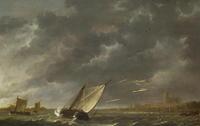
The Maas at Dordrecht in a Storm
Aelbert Cuyp
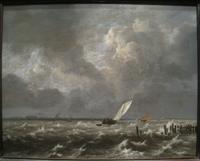
View of the Ij on a Stormy Day
Jacob van Ruisdael
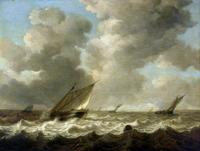
Fishing Boats in a Rough Sea
Simon de Vlieger
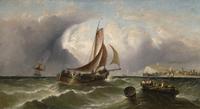
Homeward Bound
James Webb
Stormy Sea
Jacob van Ruisdael
A smalship closed hauled in a stiff breeze with a flagship offshore to the left and a jetty to the right
Aernout Smit
Stormy Sea with Sailing Vessels
Jacob van Ruisdael
Storm and rain in a Dutch harbor
Andreas Achenbach
A River Estuary
Jan van Goyen
Dutch Fishing Boats in a Storm
J.M.W. Turner
[Unkown]
Abraham Hulk Sr.
[Unkown]
Abraham Hulk Sr.
A Dutch Galliot Aground on a Sandbank on the Biesbosch, The Netherlands
Edward William Cooke
A Squally Day in a Dutch Estuary
Simon de Vlieger
Marine, Choppy Sea
Ludolf Backhuysen I
A paddle packet and a hoy off Amsterdam
Hermann Mevius
Rough Seas
William Bradford
Fishing Boats Beating up to Windward
Edward Moran