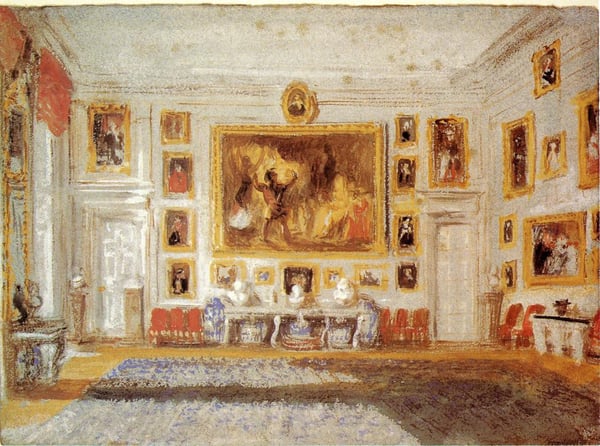
Petworth, the Drawing room, Bodycolor on blue paper
Details
Expertenanalyse zu J.M.W. Turners Petworth, the Drawing room, Bodycolor on blue paper
Stil: Romanticism · Genre: interior
Expert Analysis: "Petworth, the Drawing room, Bodycolor on blue paper" by J.M.W. Turner
Turner’s Petworth, the Drawing room is a remarkable departure from his celebrated maritime and landscape works, offering an intimate glimpse into the domestic interior of Petworth House—the estate of his patron, the Earl of Egremont. Executed in bodycolor (gouache) on blue paper, this piece exemplifies the Romantic fascination with atmosphere, light, and the transient beauty of everyday spaces.
Significance within Romanticism:
While Romanticism often turned to the sublime forces of nature or dramatic historical scenes, Turner here applies the movement’s core principles—emotional intensity, luminosity, and the evocation of mood—to a seemingly ordinary interior. The blue paper acts as a mid-tone ground, allowing him to suggest shadow and depth with restrained touches of white and warm color. This technique anticipates his later, more abstract explorations of light and color, where form dissolves into pure atmospheric effect. The drawing room becomes not just a record of aristocratic life, but a study of fleeting, golden light—a Romantic meditation on time, memory, and the quiet grandeur of human habitation.
Genre and Innovation:
Interior scenes were rare in Turner’s oeuvre, and this piece stands out for its radical handling of space and material. By using bodycolor—an opaque, creamy paint that diffuses light—he transforms an architectural interior into a shimmering, almost dreamlike vision. The blue paper (a support more typical of preparatory sketches than finished works) lends a cool undertone that heightens the warmth of the lit areas, creating a delicate tension between interior stillness and the energy of light. This approach disrupts traditional expectations of interior genre painting, which often prioritized detailed accuracy or narrative. Turner instead prioritizes sensation, making the room feel alive with the ephemeral presence of sunlight.
Legacy:
Petworth, the Drawing room reveals Turner’s genius in finding the sublime within the domestic. It foreshadows the Impressionists’ later fascination with fleeting interior light and underscores his role as a pioneer who expanded Romanticism’s boundaries beyond the epic landscape into the intimately observed world. The work’s significance lies in its daring synthesis of technique, mood, and subject—a quiet yet revolutionary moment in Turner’s career.
Museum / Gallery
Visuell ähnlich
20 Werke mit ähnlicher Komposition und Farbpalette
Salon
J.M.W. Turner
Musikalische Unterhaltung am Spinett
Heinrich Schonfeld
The Long Gallery, Hardwick Hall, Derbyshire
David Cox
The Sala de Saturne or Room of Saturn in the Pitti Palace, Florence
Fortunato Maestosi
Pitti Palace, Iliad Room
Fortunato Maestosi
Interior in Palace Windischgratz in the race in Vienna
Rudolf von Alt
Sala di Giove, Palazzo Pitti
Fortunato Maestosi
he Green Drawing Room of the Earl of Essex at Cassiobury
William Henry Hunt
The Long Gallery, Hardwick Hall, Derbyshire
David Cox
Painter at the easel
J.M.W. Turner
Interior in the Winter Palace of Prince Eugene of Savoy in Himmelpfortgasse
Carl Moll
Interior
Else Muller-Kaempff
Gatchina. Interior
Zinaida Serebriakova
State Room at Blenheim Palace
Winston Churchill
Salon in the Apartment of Count Lanckoroński in Vienna
Rudolf von Alt
Gallery of the Louvre
Samuel Morse
The Nordgalerie
J.M.W. Turner
The Artist's Studio, Rue de la Condamine
Frederic Bazille
The Opening of the Modern Foreign and Sargent Galleries at the Tate Gallery, 26 June 1926
John Lavery
The Long Gallery, Hardwick Hall, Derbyshire
David Cox