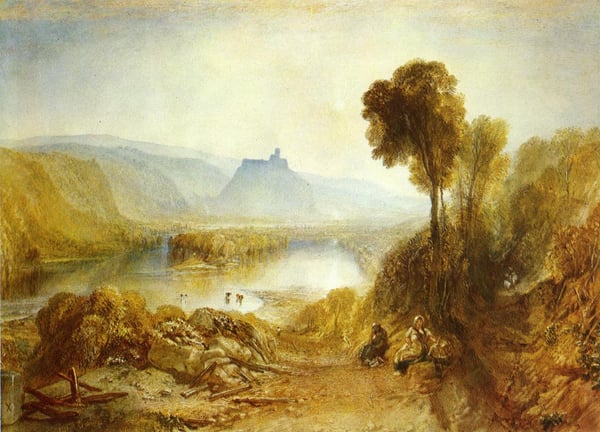
Экспертный разбор работы «Prudhoe Castle, Northumberland» художника J.M.W. Turner
Стиль: Romanticism · Жанр: landscape
Expert Analysis: Prudhoe Castle, Northumberland by J.M.W. Turner
As a quintessential work of British Romanticism, Turner’s Prudhoe Castle, Northumberland elevates a topographical view into a meditation on time, nature, and human transience. This landscape painting, executed during the artist’s mature period, demonstrates the core Romantic preoccupation with the sublime—the awe-inspiring, often overwhelming power of nature set against the fragility of human achievement.
Significance within Romanticism:
The painting’s subject—a medieval ruin perched above the River Tyne—is emblematic of the Romantic fascination with the past, particularly the Gothic and the ruined castle as a symbol of decay and mortality. Turner does not merely document the castle’s architecture; he submerges it in a diffuse, atmospheric glow. The castle itself is rendered with softened contours, nearly dissolving into the sky and mist, suggesting that nature is reclaiming the structure. This treatment aligns with the Romantic notion of the “picturesque” where irregular, weathered forms evoke melancholy nostalgia. The light—golden and hazy—infuses the scene with a sense of the sublime: fleeting, intangible, yet emotionally charged. Turner’s characteristic flickering brushwork and subtle colour harmonies (pale yellows, muted greens, and soft greys) create a veiled, almost dreamlike quality, inviting the viewer to contemplate the passage of time and the insignificance of human works before the eternal forces of nature.
Artistic Innovation:
Turner’s handling of atmosphere here is a precursor to his later, more radical experiments with light and colour. Even in this more traditionally composed landscape, he prioritises mood over topographical accuracy. The castle is less a historical document and more a vehicle for expressing transient atmospheric effects—the shimmering air, the diffused sunlight, and the reflective water imply that the true subject is not the stone ruin but the ephemeral moment of perception. This approach directly challenged the neoclassical ideal of clear, stable forms and instead celebrated the Romantic belief that feeling and imagination are the highest artistic goals. By rendering a known landmark with such poetic subjectivity, Turner redefined landscape painting as a medium for profound emotional and philosophical reflection.
Conclusion:
Prudhoe Castle, Northumberland is significant not only as a beautiful image of a Northern English ruin but as a classic embodiment of Romantic landscape art. It captures the era’s dual love for historical memory and untamed nature, while showcasing Turner’s revolutionary ability to merge fact with vision, turning a local view into a universal meditation on ruination and the sublime.
Museum / Gallery
Визуально похожие
20 работ с близкой композицией и палитрой
View of Orvieto
J.M.W. Turner
Paesaggio fluviale con viaggiatori
Jan Hackaert
The White Monk
Richard Wilson
Evening Landscape
Salvator Rosa

in the Catskills
Asher Brown Durand
Amalfi Coast
Thomas Moran
6 Amalfi Coast
Thomas Moran
Flight into Egypt
Jan Asselijn
Landscape with the Good Smaritan
Rembrandt
Italian Landscape
Jan Dirksz Both
Landscape with a River
John Crome
A Lake Scene
George Philip Reinagle

Italianate Landscape with Travellers on a Path
Jan Dirksz Both
At Matlock - mist rising
John Glover
The Bright Stone of Honour (Ehrenbreitstein) and the Tomb of Marceau, from Byron's 'Childe Harold'
J.M.W. Turner
Landscape with Paris and Oenone
Claude Lorrain
A Mountain Path
Jan Dirksz Both
An extensive river landscape with travellers on horseback
Thomas Barker of Bath
The Roman Campagna
Claude Lorrain
At Alban Hills
Arnold Böcklin