Expertenanalyse zu J.M.W. Turners Rain Steam and Speed, The Great Western Railway
Stil: Romanticism · Genre: landscape
Expert Analysis of J.M.W. Turner's Rain, Steam and Speed – The Great Western Railway (1844)
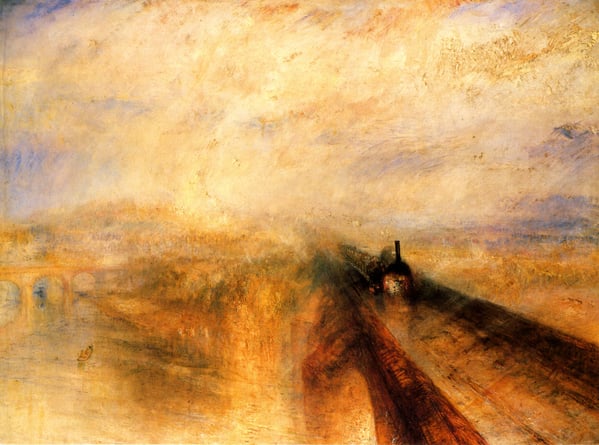
As a quintessential work of Romanticism, Turner’s Rain, Steam and Speed stands as a monumental achievement in landscape painting, redefining the genre by merging nature’s sublime power with the relentless advance of industrialization. The painting captures a moment of dynamic tension: a steam locomotive hurtles across the Maidenhead Railway Bridge in a storm of rain, mist, and blurred motion.
Significance within Romanticism and the Landscape Genre
-
The Sublime in Transition – Romanticism prized the sublime—the overwhelming, awe-inspiring force of nature. Turner here transposes that sublime energy onto a machine, treating the locomotive as a terrifying yet thrilling embodiment of modern power. The train emerges from a vortex of weather, its glowing firebox and dark silhouette pitted against the vast, turbulent sky and river below. This blurs the boundary between natural and man-made, elevating a technological marvel to the status of a Romantic phenomenon.
-
Pioneering Atmospheric Technique – Turner dissolves form into light, color, and motion. The painting is almost abstract in its handling: rain streaks diagonally, steam billows into translucent clouds, and the bridge itself is a mere suggestion of arches. This approach anticipated Impressionism, yet its core remains deeply Romantic—an emotional response to an elemental struggle. The landscape genre is pushed beyond mere depiction into an experience of sensory overload.
-
Historical and Cultural Commentary – The Great Western Railway, a marvel of Victorian engineering, symbolizes progress. Turner does not simply celebrate it; he dramatizes its intrusion into the pastoral. A tiny hare races ahead on the tracks, a poignant symbol of nature fleeing from speed. This dualism—exhilaration and loss—embodies Romanticism’s conflicted response to the Industrial Revolution. The painting is both a eulogy for a vanishing world and a hymn to the new.
-
Technical Mastery – Turner’s use of a predominantly golden-brown and pearl-gray palette, punctuated by the fiery orange of the engine, creates a cohesive yet volatile harmony. The rapid, almost calligraphic brushwork lends urgency, while the contrast between the sharp, dark train and the soft, dissolving landscape reinforces the thematic clash.
In sum, Rain, Steam and Speed is a landmark of Romantic landscape painting because it synthesizes nature’s sublime terror with humanity’s technological ambition, all while pushing the boundaries of painterly expression. It captures a pivotal moment when speed and industry reshaped both the physical world and the Romantic imagination.
Museum / Gallery
Visuell ähnlich
20 Werke mit ähnlicher Komposition und Farbpalette
The Thames Above Waterloo Bridge
J.M.W. Turner
The Burning of the Houses of Parliament
J.M.W. Turner
Waterloo Bridge, Dawn
Claude Monet
Charing Cross Bridge 3
Claude Monet
Boats on the Thames, Fog Effect
Claude Monet
Waterloo Bridge, Sunlight in the Fog
Claude Monet
Charing Cross Bridge, Fog on the Themes
Claude Monet
Charing Cross Bridge 02
Claude Monet
Waterloo Bridge, Fog
Claude Monet
Yacht Approaching the Coast
J.M.W. Turner
Charing Cross Bridge
Claude Monet
Charing Cross Bridge, The Thames 02
Claude Monet

The Lake, Petworth, Sunset; Sample Study
J.M.W. Turner
Nocturn Sun
James McNeill Whistler
Charing Cross Bridge
Claude Monet
Charing Cross Bridge, Overcast Weather
Claude Monet
Approach to Venice
J.M.W. Turner
Charing Cross Bridge
Claude Monet
Charing Cross Bridge, The Thames
Claude Monet
Plain when it gets dark
Giovanni Segantini