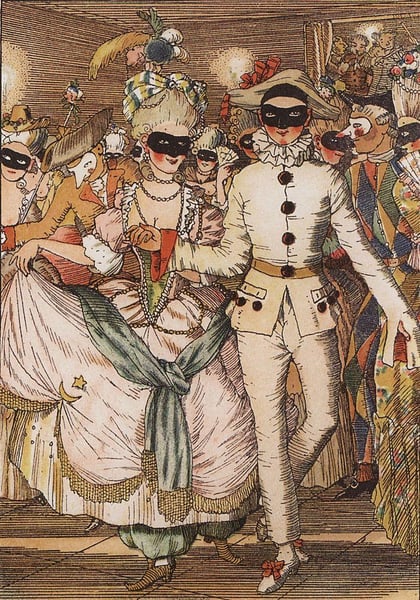
Book of the Marquise. Illustration 8
Details
Expert analysis of Konstantin Somov’s Book of the Marquise. Illustration 8
Style: Symbolism · Genre: illustration
Konstantin Somov’s Book of the Marquise. Illustration 8 (c. 1907–1912) stands as a quintessential example of Russian Symbolism’s fascination with the artificial, the erotic, and the nostalgic. Executed as part of a celebrated illustrated edition of French libertine poetry (often attributed to the 18th-century writer Charles Perrault or, more accurately, to the Book of the Marquise by the poet and critic Mikhail Kuzmin), this work merges a meticulous revival of Rococo aesthetic with a distinctly fin-de-siècle sense of decadence and psychological tension.
Significance within Symbolism and its Period
-
Reimagining the Rococo: Somov, a leading figure of the Mir iskusstva (World of Art) group, revived the playful, ornate style of 18th-century French painting—replete with powdered wigs, silks, and amorous gazes—but infused it with a Symbolist’s unease. In this illustration, the marquise is not merely a decorative figure; her composed, slightly melancholic expression suggests a world of concealed desire and impending tragedy. The pastel palette and delicate linework recall Watteau or Fragonard, yet the cropped composition and the figure’s inward gaze break the illusion of carefree gallantry, introducing a modern psychological depth.
-
Erotic Ambiguity and Decadence: The Book of the Marquise series is openly erotic, but Somov treats the theme with a refined, almost clinical elegence. Illustration 8 likely shows a moment of intimate play or a hint of masquerade—common motifs in the series. The work’s significance lies in how it balances explicit sensuality with restraint, making it a hallmark of Symbolist “decadence”: beauty tinged with morbidity. The artificiality of the setting (the marquise is often shown with a mask, fan, or mirror) underscores the Symbolist preoccupation with theatricality and the fleeting nature of pleasure.
-
Hybrid of Genre and Illustration: As an illustration, the piece was created to accompany text, but Somov elevates the genre by treating each image as an autonomous work of graphic art. The careful use of watercolor or gouache (typical for Somov) and the integration of decorative borders or vignettes (not seen in this single sheet) show how he blurred the line between book art and fine art. This aligns with the Symbolist belief that all arts should merge to create a total aesthetic experience—a core principle of the Mir iskusstva movement.
-
Russian Symbolist Identity: Somov’s work is significant because it proves Russian artists could master Western European stylistic languages (Rococo, Symbolism) while infusing them with a uniquely Russian introspective melancholy. The Book of the Marquise illustrations were highly controversial in their day for their overt eroticism, but they also cemented Somov’s reputation as a master of the “gallant scene” who transformed 18th-century frivolity into a vehicle for Symbolist introspection.
In summary, Book of the Marquise. Illustration 8 is significant as a bridge between historical revival and modernist sensibility. It captures the essence of Symbolism: a longing for a lost, exquisite world, coupled with an acute awareness of its artificiality and transience. Somov’s ability to make a single illustration resonate with both erotic charge and existential fragility marks it as a key work of the period.
Museum / Gallery
Visually similar
20 works with related composition and palette
Book of the Marquise. Illustration 1
Konstantin Somov
Cinderella
Gustave Dore
Deux grisettes et deux soldats
Constantin Guys
The Battle of the Beaux and the Belles
Aubrey Beardsley
Lady and Harlequin
Konstantin Somov
Book of the Marquise. Illustration 5
Konstantin Somov
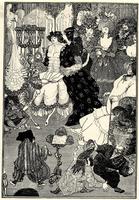
The Toilet of Helen
Aubrey Beardsley
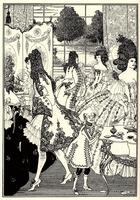
Illustration for 'The Rape of the Lock' by Alexander Pope
Aubrey Beardsley
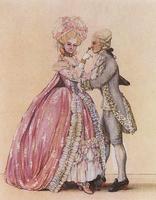
How Dressed in the Old Days (Lady and Cavalier)
Konstantin Somov
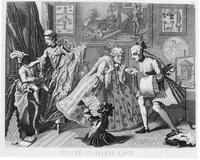
Taste in High Life
William Hogarth
Féerie in Tre Atti E 16 Quadri
Leopoldo Metlicovitz
Die Prinzessin Und Der Schweinehirt
Heinrich Lefler
Picnic. Illustration to the Book of the Marquise
Konstantin Somov
Book of the Marquise. Illustration 6
Konstantin Somov
Shepherds and Shepherdess
Serge Sudeikin
Italian Comedy 2
Konstantin Somov
Press Illustration of Act 1 of the Premiere of Jacques Offenbach's Operetta La Grande-duchesse De Gérolstein at the Théâtre Des Variétés in Paris on 12 April 1867 from L'univers Illlustré (27 April 1867)
Edouard Riou
CHRISTMAS EVE
John Leech
Albert in search of his ideals
Aubrey Beardsley
Illustration to "A Week of Kindness"
Max Ernst