
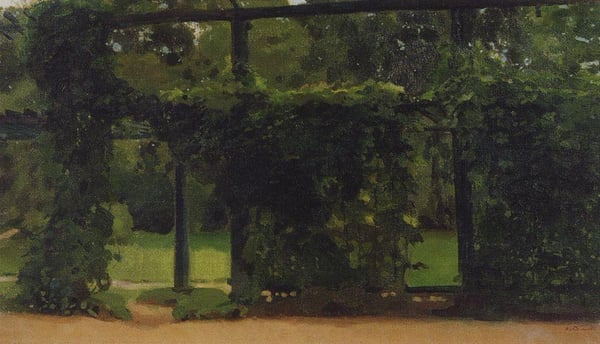
Analisi esperta di Bosquet di Konstantin Somov
Stile: Symbolism · Genere: landscape
Expert Analysis of "Bosquet" by Konstantin Somov
As a Symbolist landscape, "Bosquet" (meaning "grove" in French) by Konstantin Somov exemplifies the movement’s signature shift away from direct naturalism toward a world of introspection, nostalgia, and refined artifice. The work is significant for several reasons:
-
Embodiment of Symbolist Ideals
Somov transforms a simple grove into a dreamlike, theatrical space. The landscape is not a realistic depiction but a constructed, mood-driven scene that invites contemplation. The “bosquet” evokes the formal, clipped gardens of 18th-century France—a recurring motif in Somov’s art—blurring the boundary between nature and human fantasy. This aligns with Symbolism’s pursuit of inner truth through evocative, often nostalgic imagery. -
Mastery of Decorative Elegance
Somov, a core member of the Russian Symbolist group Mir iskusstva (World of Art), was celebrated for his meticulous technique and love of Rococo aesthetics. In Bosquet, the careful arrangement of trees, the soft, pastel palette, and the almost porcelain-like finish create a sense of delicate, artificial beauty. The composition feels staged—a vision of an idealized past rather than a living forest—reflecting Somov’s fascination with the “theatre of memory.” -
Blurring of Reality and Fantasy
The significance of Bosquet lies partly in its ambiguity. The grove is empty of people, yet feels inhabited by a ghostly, melancholy presence. This emptiness invites the viewer to project their own emotions onto the scene, a hallmark of Symbolist landscape. Somov’s treatment of light and shadow—luminous yet muted—suggests a twilight or dream state, where nature becomes a mirror for the soul. -
Cultural and Historical Resonance
Painted during a period of social upheaval in Russia (early 20th century), Bosquet represents an escape into a refined, cosmopolitan past. By evoking the French word bosquet, Somov aligns himself with a pan-European fin-de-siècle sensibility, rejecting raw realism in favor of artifice and reverie. This makes the work a key document of Russian Symbolism’s internationalist and retrograde tendencies.
In summary, "Bosquet" is significant for its perfect synthesis of Symbolist escapism, decorative Rococo revival, and Somov’s personal vision of nature as a stage for memory and longing. It stands as a jewel of the Mir iskusstva movement, demonstrating how landscape could be used not to document the external world, but to construct a lyrical, bittersweet interior one.
Visivamente simili
20 opere con composizione e palette affini
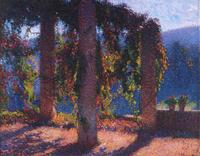
The Pergola in Marquayrol
Henri Martin

The Garden Bower at Finzean
Joseph Farquharson
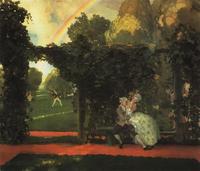
The Laughed Kiss
Konstantin Somov

The pergola
Silvestro Lega
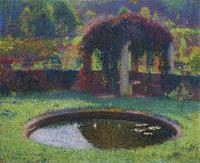
Pergola in the South West Park
Henri Martin

Fountain in Marquayrol
Henri Martin

The Small Pergola
Henri Martin
Under an Arbour
Max Slevogt
Young Women in Tonnelle
Henri Martin

A Rose Trellis (Roses at Oxfordshire)
John Singer Sargent
The Arbour in Autumn
Henri Martin
Landscape with a Rainbow
Konstantin Somov
A Villa at the Riviera
Winston Churchill
Bench
Edouard Manet
The Terrace
Henri Martin
Jeanne-Marguerite Lecadre in the Garden
Claude Monet

Mandorli Ad Algeri
Georges Rochegrosse

Landscape with figure
Joan Brull

Flowered glimpse
Angelo Morbelli
Girl in a Wickford Garden, New England
Guy Rose