
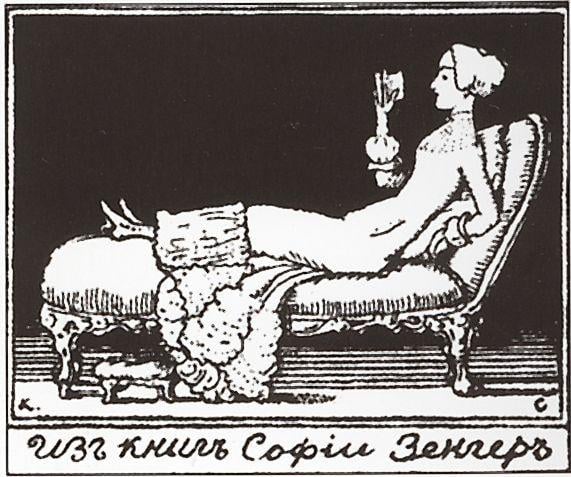
Expert analysis of Konstantin Somov’s Exlibris of S. Zenger
Style: Symbolism · Genre: design
The "Exlibris of S. Zenger" by Konstantin Somov stands as a quintessential example of Russian Symbolist graphic design, capturing the movement’s fusion of refined decorative elegance, introspective mood, and esoteric personal symbolism. Created for a private collector (S. Zenger), this bookplate is not merely a functional ownership mark but a miniature portal into a dreamlike, intensely stylized world—a hallmark of Somov’s contribution to the Mir iskusstva (World of Art) circle.
Significance within Symbolism and its period:
-
Art as Personal Emblem: In the Symbolist ethos, art was a vehicle for subjective, often enigmatic meaning. Somov’s exlibris transforms a utilitarian object into a hermetic emblem that reflects the owner’s taste and the artist’s poetic vision. The composition likely employs allegorical figures, mythological references, or delicate eroticism (common in Somov’s work) to evoke a sense of intimate reverie, distancing the viewer from the mundane and into a realm of psychological nuance.
-
Graphic Mastery and the Fin-de-Siècle Aesthetic: Somov was celebrated for his exquisite line work and sensitivity to surface decoration, which he inherited from Rococo and Art Nouveau sources. In this exlibris, the design genre allowed him to distill his characteristic traits—sinuous contours, meticulous hatching, and a palette of muted, dusty pastels (if colored) or delicate black-and-white—into a compressed composition. The piece exemplifies how Symbolist artists elevated the applied arts to a fine art status, challenging hierarchies and affirming the total work of art (Gesamtkunstwerk).
-
Nostalgic and Melancholic Atmosphere: Typical of Somov and the Symbolist mood, the exlibris likely evokes a bygone, melancholic elegance—perhaps through a languid figure, a theatrical setting, or references to commedia dell’arte or pastoral idylls. This backward glance, tinged with irony and decay, reflects the period’s fascination with the artificial and the decadent, where beauty is intertwined with transience.
-
Integration of Private and Public: As a bookplate, the work bridges the private world of the collector (S. Zenger) and the public dissemination of the artist’s style. It demonstrates how Symbolism permeated everyday objects, making the intimate act of opening a book a moment of aesthetic and symbolic encounter.
In sum, the "Exlibris of S. Zenger" is significant for encapsulating the Symbolist ideal of art as a refined, coded experience—where design, mystique, and meticulous craftsmanship converge to create a silent, resonant dialogue between artist, owner, and viewer.
Visually similar
20 works with related composition and palette
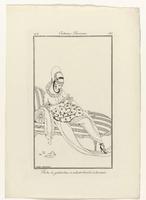
Journal Des Dames Et Des Modes, Costumes Parisiens, 1914, No. 162: Robe De Gabardine
Gerda Wegener
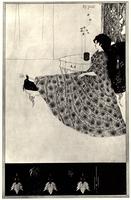
Rejane
Aubrey Beardsley
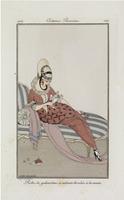
Dress with Hand Embroidered Ruffles
Gerda Wegener
Nu Sur La Chaise Longue
Henri Matisse
Dangerous Liaisons
George Barbier
Portrait of Maria Ryazantseva
Boris Kustodiev
Woman on sofa
Pyotr Konchalovsky

Lady in pink (Artist's sister Anna Rozanova)
Olga Rozanova
Untitled
Lucia Demetriade Balacescu
The Model. Sketch for painting 'Woman on the couch. "
Pyotr Konchalovsky

Untitled
Lewis Carroll
Illustration to "A Week of Kindness"
Max Ernst

The Letter
Jack Vettriano
Seated woman
Umberto Boccioni
Annunciation
Kit Williams
The Lying Woman Or Lying Girl
Leonor Fini
Lady in furs
Mikhail Vrubel
Circus Girl Resting
Yasuo Kuniyoshi
Portrait of Aydan Salahova
Tahir Salahov
Atmosphaere
Gerda Wegener