Expert analysis of Konstantin Somov’s Fireworks in the Park
Style: Symbolism · Genre: genre painting
Expert Analysis: "Fireworks in the Park" by Konstantin Somov
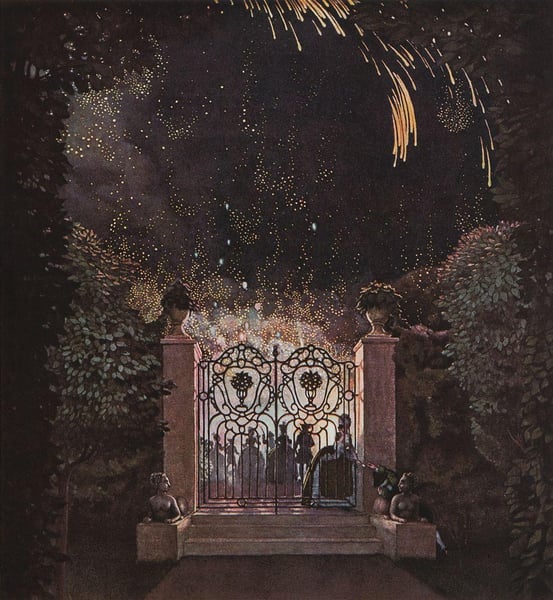
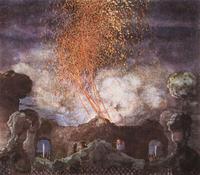
This work, a genre painting executed in the Symbolist style, exemplifies Konstantin Somov’s unique ability to fuse historical nostalgia with a deeply subjective, dreamlike atmosphere. "Fireworks in the Park" depicts a nocturnal garden scene where elegant figures, likely from the 18th-century ancien régime, gather to watch a burst of pyrotechnic light. The painting’s significance lies in how it transforms a seemingly simple social pastime into a meditation on transience, artifice, and memory.
Symbolist Language and Mood
Somov rejects straightforward realism in favor of a highly stylized, theatrical composition. The fireworks themselves become a symbol of fleeting beauty and ephemeral joy—a classic Symbolist motif. The figures are often rendered as mannequin-like or mask-like, their faces partially obscured or turned away, suggesting a world of borrowed identities and hidden emotions. The park setting, with its manicured trees and classical statuary, feels less like a real place and more like a stage set for a masquerade. This deliberate artificiality underscores the Symbolist fascination with the tension between appearance and reality.
Color and Light
Somov employs a muted, pastel palette punctuated by the sharp, golden-white sparks of the fireworks. The contrast between the cool, silvery moonlight and the warm, fleeting glow of the explosions creates a visual rhythm of hope and melancholy. The light does not illuminate clearly but instead dissolves forms into soft, painterly patches—evoking the haziness of memory or a fading dream. This handling of light is crucial to the work’s significance: it merges the external spectacle with an internal, psychological state.
Historical and Stylistic Context
As a leading member of the Russian World of Art group, Somov was deeply influenced by 18th-century French rococo (Watteau, Fragonard) and the Symbolist movement. "Fireworks in the Park" is significant for its synthesis of these influences: the rococo love of elegant leisure and pastoral fantasy is filtered through a fin-de-siècle sensibility of decay and longing. The painting does not celebrate the past but rather mourns its irretrievable loss. This elegiac quality—a hallmark of Somov’s best work—places the painting at the intersection of nostalgia and modern anxiety.
Conclusion
In "Fireworks in the Park," Somov achieves a delicate balance between storytelling and abstraction, realism and symbol. The artwork’s significance lies in its ability to make the viewer feel the fragility of a single moment—the burst of fireworks, the rustle of silk, the silent exchange of glances—as both a historical echo and a universal human experience. It is a masterwork of Symbolist genre painting, where the ordinary becomes a portal to a more mysterious, emotionally charged world.
Visually similar
20 works with related composition and palette
Date night
Konstantin Somov
Das Schlossportal
Ferdinand Knab
Am Schlosstor
Ferdinand Knab
Magic Garden (Night Vision)
Konstantin Somov
The Grid
Raoul Dufy
Gateway
Roberto Montenegro
The gate and the road to "Etyup"
Anna Ostroumova-Lebedeva
Strawberry Fields
Jacek Yerka
Shadows
Valeria Trubina
The school friend
Don Kenn
The gate
Santiago Rusinol
Courtyard Fountain
Hiro Yamagata
Scetch for Ostrovsky's "Wolves and Sheep"
Boris Kustodiev
I like the Sorrow
Jacek Yerka
Fireworks
Konstantin Somov
Illustration for The Ural Tales
Vyacheslav Nazaruk
Letter (Mysterious Messenger)
Konstantin Somov
Revolt (By the Gates of a Park)
Kathe Kollwitz
At the Villa Borghese
Lorenzo Valles
Kirkegaarden Paa Braatebakken
Theodor Severin Kittelsen