Analisi esperta di In the Park of Versailles di Konstantin Somov
Stile: Symbolism · Genere: landscape
Expert Analysis of "In the Park of Versailles" by Konstantin Somov
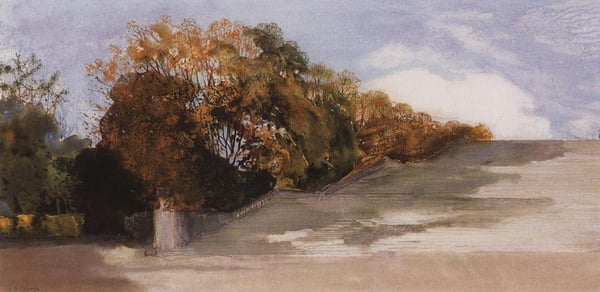
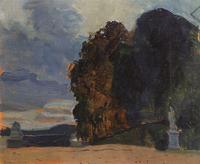
Konstantin Somov’s In the Park of Versailles is a quintessential embodiment of Symbolist landscape painting, merging meticulous observation of a real, historic site with the movement’s hallmark preoccupations—nostalgia, artificial beauty, and the melancholic passage of time. Painted against the backdrop of late 19th- and early 20th-century Russian Symbolism (closely tied to the Mir iskusstva / World of Art group), the work transforms the famous French gardens into a stage for a dreamlike, decayed elegance.
Significance within Symbolism and the Period:
-
The Landscape as a Symbolist Stage
Unlike a straightforward topographical view, Somov’s painting uses the park of Versailles not as a tourist attraction but as a symbol of a bygone, aristocratic world. The meticulously trimmed hedges, serene pools, and classical statuary become props in a silent drama of loss. The figures—if present—are often ghostly, doll-like, or absorbed in reverie, emphasizing a sense of unreachable memory. This aligns with Symbolism’s rejection of naturalistic depiction in favor of mood and inner emotion. -
Nostalgia and the Artificial Paradise
Somov was deeply influenced by the Rococo revival, and In the Park of Versailles directly invokes the 18th-century French fête galante tradition (e.g., Watteau). Yet he filters it through a fin-de-siècle sensibility: the powdered wigs and silks feel like costumes for a masquerade that has already ended. The park becomes a memento mori for a vanished culture—a key Symbolist theme of decadence and the transience of pleasure. -
Russian Gaze on French Heritage
As a Russian artist working within the Mir iskusstva circle, Somov’s Versailles paintings (he produced several) represent a fascinating cross-cultural dialogue. The group championed a return to decorative, pre-Realist aesthetics, and Somov treats the French palace with the same refined, slightly ironic tenderness that his peers reserved for Russian folklore or 18th-century St. Petersburg. This fusion makes the work significant as an example of European Symbolism’s international reach—where a Russian artist could reimagine a French landmark as a universal symbol of existential longing. -
Refined Technique and Color
Somov’s palette in this work—pale greens, powdery blues, ivory whites—creates an almost artificial, porcelain-like surface. The brushwork is smooth and precise, avoiding Impressionism’s spontaneity. This polished finish mirrors the park itself: a manmade, controlled “nature” that is both beautiful and sterile. The significance lies in how technique reinforces meaning—the act of painting becomes a deliberate act of preservation, like fixing a fading memory in amber.
Conclusion:
In the Park of Versailles is significant because it distills Symbolism’s core tension—beauty and decay, reality and dream—into a single, haunting vista. It stands as a masterful example of how the Mir iskusstva artists adapted Western European traditions (Rococo, Symbolism) to articulate a distinctly Russian sense of melancholic refinement. Somov’s park is not a place to visit but a world to slip into—a perfect, frozen past that never truly existed, yet feels achingly real.
Visivamente simili
20 opere con composizione e palette affini
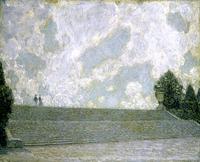
Steps of the Palace at Versailles
Henri Le Sidaner
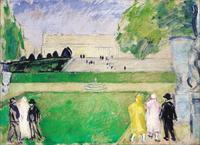
Vaszary János, Versailles 1925
Vaszary János
Frühmesse
Giovanni Segantini
Piazza di Spagna, Rome
Childe Hassam
The Spanish Steps, Rome
Childe Hassam
Essentuki. Stairs.
Pyotr Konchalovsky
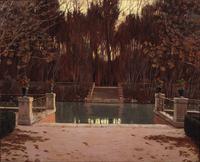
The landing stage
Santiago Rusinol
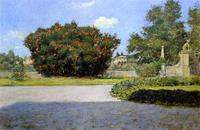
The Big Oleander
William Merritt Chase
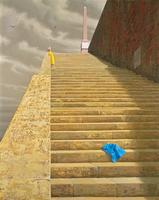
The Steps
Jeffrey Smart
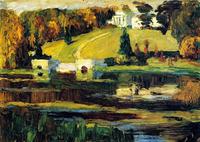
Okhtyrka, autumn
Wassily Kandinsky
Steps in Paris
Edward Hopper
Prospect Park, Brooklyn
William Merritt Chase
In the Park at St. Cloud
Childe Hassam
Deluge (I)
Mikalojus Konstantinas Ciurlionis
Volga
Boyukagha Mirzazade
View of Ripetta
Hubert Robert
Female figure in a landscape
Ilya Repin
Stair study
Giovanni Segantini
In the Park of Versailles
Konstantin Somov
Autumn at Versailles
Fujishima Takeji