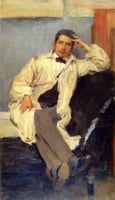
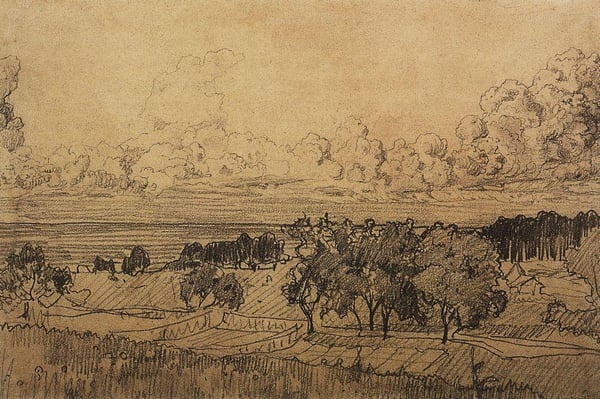
Landscape
Expertenanalyse zu Konstantin Somovs Landscape
Stil: Symbolism · Genre: landscape
Expert Analysis of Landscape by Konstantin Somov
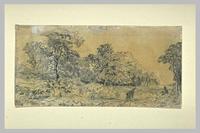
Konstantin Somov’s Landscape is a quintessential example of Russian Symbolist painting, where the natural world becomes a stage for memory, mood, and metaphysical longing. While the specific composition is not detailed, Somov’s broader body of work—especially his landscapes—reveals a consistent approach that makes this piece significant within the Symbolist movement.
Significance within Symbolism:
Symbolist landscapes reject direct observation and naturalistic representation in favor of subjective, dreamlike vistas. Somov’s Landscape likely embodies this by transforming a seemingly ordinary scene into an atmospheric reverie. His use of muted, pastel-like palettes, soft edges, and a pervasive sense of stillness evokes a world suspended in time—a hallmark of Symbolist aesthetics. The composition may feature a park, garden, or rural setting, but its true subject is the emotional resonance of decay, nostalgia, and elusive beauty.
Theatricality and Historical Reminiscence:
Somov was a founding member of the World of Art group, which championed a synthesis of modernity and historical revivalism. In Landscape, this manifests as a deliberate anachronism: the scenery might recall the pastoral elegance of 18th-century French fêtes galantes (a la Watteau) or the melancholic refinement of Rococo gardens. However, Somov filters this through a contemporary Symbolist lens, imbuing the scene with a haunting fragility. The landscape becomes a stage for unseen dramas—a silent, melancholy tableau vivant where nature mirrors the artist’s inner solitude.
Technical Distinction:
Somov’s brushwork is characteristically precise yet delicate, often executed on a small scale to enhance intimacy. The Landscape likely employs thin, glazed layers of oil or gouache, creating a matte, almost porcelain finish. This technique aligns with the Symbolist preference for artifice over raw expression, emphasizing the painting as a crafted object—a “window” into an idealized, irretrievable past.
Comparison to Peers:
Unlike Victor Borisov-Musatov’s spectral, lyrical scenes or Mikhail Vrubel’s demonic intensity, Somov’s landscape tradition remains closer to decadent refinement. His work anticipates the fin de siècle fascination with the ephemeral, influencing later Russian Symbolists and even early 20th-century decorative arts. The Landscape stands as a quiet rebellion against both academic realism and emerging modernism, championing instead a poetic, introspective visual language.
Conclusion:
Konstantin Somov’s Landscape is significant not for its topographical accuracy, but for its ability to transform a mundane view into a psychological space—a tender, wistful elegy for a world that never truly existed. It encapsulates Symbolism’s core mission: to see beyond the visible, and to make the invisible—memory, desire, fleeting beauty—palpable.
Visuell ähnlich
20 Werke mit ähnlicher Komposition und Farbpalette
Landscape with Lake
Konstantin Somov
The plain of Barbizon
Theodore Rousseau
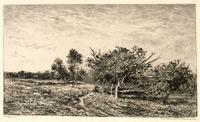
Apple Trees at Auvers
Charles-Francois Daubigny
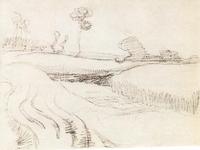
Little Stream Surrounded by Bushes
Vincent van Gogh
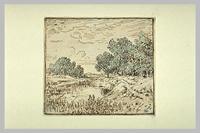
Clumps of trees along a river
Theodore Rousseau
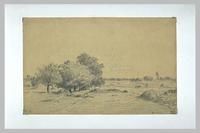
Lowland landscape
Theodore Rousseau
Wheat Fields
Vincent van Gogh
Dumka Landscape 1
Safiuddin Ahmed
Pastures in Normandy
Jean-Francois Millet
River floods, such as seas
Ivan Shishkin
Landscape with a Wayfarer
Adam Elsheimer
The valley of Bièvre near Paris
Theodore Rousseau

A Village in Summerset
Giorgio de Chirico
Field of Rye
Camille Pissarro
The Effect of Sunlight
Camille Pissarro
Cloud
Nicholas Roerich
Clouds over the grove
Ivan Shishkin
The Oise Valley
Paul Cezanne
“Paysage”
Ker-Xavier Roussel
Carrier bundles of wood on the edge
Theodore Rousseau