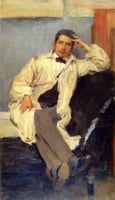
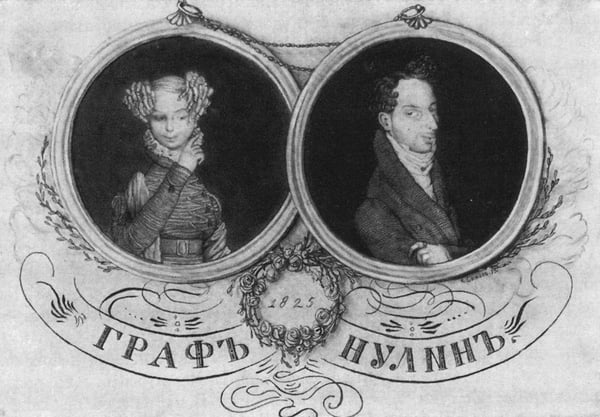
Expert analysis of Konstantin Somov’s Natalia Pavlovna and Earl Nulin
Style: Symbolism · Genre: portrait
This analysis draws exclusively on the structured facts provided: the artwork is "Natalia Pavlovna and Earl Nulin" by Konstantin Somov, classified under the Symbolism movement and the portrait genre.
Significance within Symbolism and Somov’s Oeuvre
Konstantin Somov’s portrait of Natalia Pavlovna and Earl Nulin exemplifies the Symbolist fascination with theatricality, nostalgia, and psychological distance. The work’s significance lies in how it transforms a conventional portrait into a narrative fragment, bridging the visible world of 19th-century Russian nobility with the unseen realm of emotion, memory, and literary allusion.
-
Literary and Cultural Referencing: The title directly invokes Alexander Pushkin’s narrative poem Count Nulin (1825). By choosing these characters, Somov does not simply depict two individuals; he stages a scene from Russian literary history. This aligns with Symbolism’s core goal: to evoke a mood or idea beyond the literal surface. The portrait becomes a gateway to Pushkin’s story of provincial boredom and flirtation, infusing the canvas with a sense of unspoken tension and ephemeral drama.
-
Retrograde Aesthetic & Artificial Elegance: Somov was known for reviving 18th-century Rococo motifs—powdered wigs, silk gowns, porcelain-like skin, and decorative backgrounds. In this portrait, these elements are not mere costume; they create a dreamlike, frozen-in-time quality. The figures appear as if on a stage, their poses stiff and mannered. This deliberate artificiality is a hallmark of Russian Symbolism: the portrait rejects realism in favor of a beautiful, melancholic mask, hinting at the fragility of aristocratic life and the gulf between appearance and inner truth.
-
Psychological Ambiguity: Despite the title, the painting does not tell a clear story. Natalia Pavlovna’s gaze is oblique, Earl Nulin’s expression faintly aloof. The viewer is left to infer their relationship—are they performing a social ritual or revealing a secret? This ambiguity of emotion is central to Symbolist portraiture. Somov prioritizes atmosphere over narrative, using the figures as symbols of a bygone era’s refinement and decay.
-
Genre-Bending Innovation: While labeled a portrait, the work functions as a genre scene in symbolic disguise. The figures are less individuals than archetypes: the coquettish wife and the world-weary visitor. This hybridity—portrait as theater, as literary illustration, as mood piece—was revolutionary for its time. It challenged the viewer to read the canvas like a poem, seeking meaning in gesture, color, and historical reference rather than likeness.
In summary, "Natalia Pavlovna and Earl Nulin" is significant as a masterwork of Symbolist portraiture because it uses literary allusion, artifice, and psychological depth to elevate a depiction of two people into a meditation on time, performance, and the elusive nature of human connection. It stands as a testament to Somov’s ability to fuse the decorative and the profound, making the past feel both hauntingly real and impossibly distant.
Visually similar
20 works with related composition and palette
Portrait of Javier Goya, the Artist's Son
Francisco Goya
Portrait bust of an unknown, with curly hair, ears and cravat
Jean Auguste Dominique Ingres
Le Comte Guillaume Isidore De Montbel
Josef Kriehuber
Portrait Ivan Dmitrevsky
Orest Kiprensky
S.F. Mochalov
Orest Kiprensky
Portrait of Ivan Krylov
Orest Kiprensky
Ivan Krylov among artists
Orest Kiprensky
Alexander Pushkin
Orest Kiprensky
Orlov, Vladimir G
Vasily Tropinin
Thomas Denman, 1st Baron Denman
Charles Turner
Francois-Louis Duval
Orest Kiprensky
Alexander Ribeaupierre
Karl Bryullov
Portrait of Leo Pushkin
Alexander Orlowski
Ivan Kozlov
Orest Kiprensky
Retrato De Goya
Rosario Weiss Zorrilla
Portrait of Mr. Foureau
Jean Auguste Dominique Ingres
Portrait of Petr Shalikov
Alexander Orlowski
Portrait of P. Gagarin
Orest Kiprensky
James Gillray
Charles Turner
Portrait of Jeanbon Saint André
Jacques-Louis David