
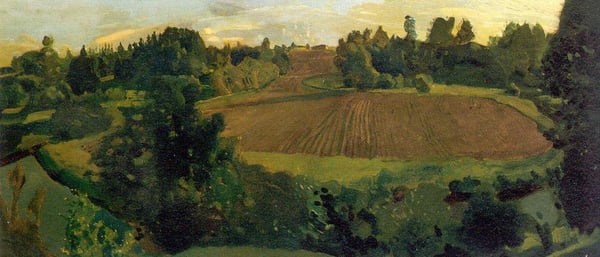
Expert analysis of Konstantin Somov’s Ploughland
Style: Symbolism · Genre: landscape
Expert Analysis: "Ploughland" by Konstantin Somov
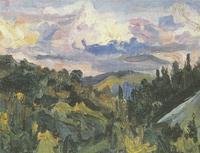
Konstantin Somov’s Ploughland is a striking example of how Symbolist landscape painting transcends mere topographical representation to become a vehicle for psychological and spiritual mood. Created within the orbit of the Russian Mir iskusstva (World of Art) group, Somov consistently favored a retrospective, almost theatrical vision of nature—one that merges meticulous observation with a dreamlike, often melancholic atmosphere.
Key Elements of Symbolist Significance:
-
From Realism to Inner Vision
While the subject—a freshly ploughed field—belongs to the traditional landscape repertoire, Somov subverts its literalness. The furrows are rendered with a rhythmic, almost decorative precision, yet the overall composition leans away from documentary clarity toward a subjective, poetic experience. The earth itself becomes a symbol of cyclic renewal, labor, and the quiet permanence of the Russian countryside. -
Nostalgia and Temporal Ambiguity
Somov’s landscapes frequently evoke a sense of temps perdu—a lost, idyllic past. In Ploughland, the absence of human figures or modern interference suggests an eternal, preindustrial rhythm. The light, often described as “pale gold” or “luminous grey,” casts a hush over the scene, reinforcing the Symbolist belief that nature is a mirror of the artist’s inner state: serene, solitary, and touched by gentle melancholy. -
Decorative Flatness vs. Spatial Depth
A hallmark of Somov’s style is the tension between two-dimensional pattern and three-dimensional space. The ploughed lines may function as abstract, linear motifs that draw the eye across the canvas, while the horizon remains deliberately soft and undulating. This delicate balancing act—between naturalism and stylization—gives the work its distinctive “artificial” beauty, a key feature of Symbolism that seeks not to copy nature but to reimagine it. -
Cultural Resonance: The Russian Landscape as Icon
For the Mir iskusstva circle, rural scenes like Ploughland were not merely picturesque; they carried national-romantic undertones. The ploughed field embodies the ancestral connection to the land, a theme that resonated with Russian intellectuals of the early twentieth century who feared urbanization and cultural loss. Somov’s treatment transforms the ordinary field into a sacred, timeless relic—a visual elegy for a vanishing way of life.
Why This Work Matters:
Ploughland exemplifies Symbolism’s ability to invest a humble landscape with profound emotional and philosophical weight. Where earlier Realists might have documented the farmer’s labor, Somov instead captures the silence after the plough, the earth as a threshold between seasons, and the artist’s own introspective gaze. The painting stands as a testament to Somov’s skill in fusing the decorative elegance of Art Nouveau with the deep, often somber introspection of Symbolism—making it a significant contribution to early modern Russian painting and a key piece in understanding the broader Symbolist movement’s approach to nature.
Visually similar
20 works with related composition and palette
East Bergholt Rectory
John Constable
Dark Trees, Cincinnati
John Henry Twachtman
Landscape. Wind
Pavel Filonov
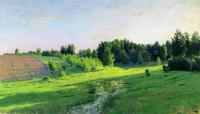
Evening shadows
Isaac Levitan
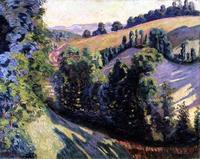
Landscape at Pontgibaud
Armand Guillaumin
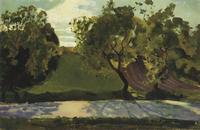
Green Slope on the Road. Martyshkino
Konstantin Somov
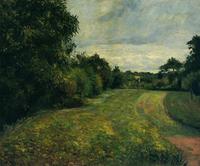
The backwoods of St. Antony, Pontoise
Camille Pissarro
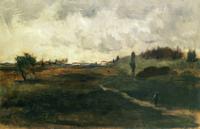
Landscape
John Henry Twachtman
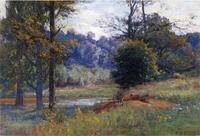
Along the Creek
T. C. Steele
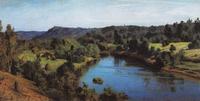
The River Oyat
Vasily Polenov
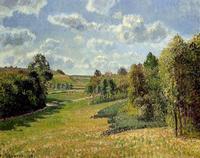
Berneval Meadows, Morning
Camille Pissarro
Forest river
Arkady Rylov
Landscape
Alfred Parsons
Landscape with Dunes
Vincent van Gogh
Flying Shadows
Willard Metcalf
Mountainous riverbank of Oyat
Vasily Polenov
The field
Nicolae Tonitza
Banks of the River
Pierre-Auguste Renoir
Farm in Brittany
Paul Gauguin
Evening Approaches
Oleksa Novakivskyi