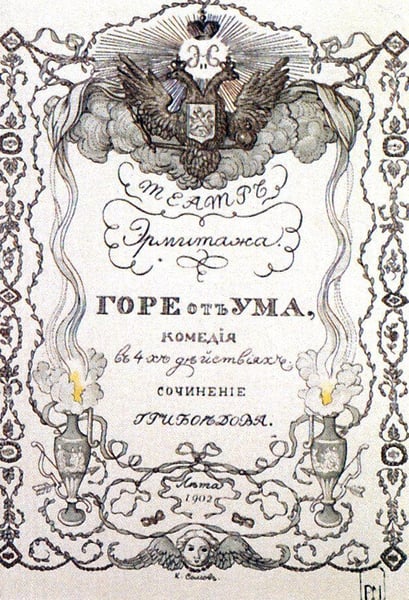
Program Performance Theatre Hermitage on the play Griboedov 'Woe from Wit', May 31, 1902
Details
Expert analysis of Konstantin Somov’s Program Performance Theatre Hermitage on the play Griboedov 'Woe from Wit', May 31, 1902
Style: Symbolism · Genre: design
Expert Art Historical Analysis:
Konstantin Somov’s Program Performance Theatre Hermitage on the play Griboedov 'Woe from Wit', May 31, 1902 is a quintessential example of Russian Symbolist design, demonstrating the movement’s deep engagement with theatricality, historical allusion, and the synthesis of visual and literary arts. As a program cover—a functional design object—the work transcends mere decoration to become a microcosm of Somov’s artistic philosophy and the broader aims of the Mir iskusstva (World of Art) group.
Significance within Symbolism and Design:
-
Synthesis of the Arts: Symbolism championed the merging of different artistic mediums to evoke mood and meaning. Somov’s program cover unites graphic design, typography, and pictorial imagery, treating the ephemeral performance leaflet as a refined art object. The layout and ornamentation echo the era’s fascination with the Gesamtkunstwerk (total work of art), where every element—from the lettering to the framing border—contributes to a nostalgic, theatrical atmosphere.
-
Historical Stylization and Retrospection: Somov frequently drew on 18th-century rococo and early 19th-century Biedermeier aesthetics. For a play by Griboedov written in the 1820s but still resonant in 1902, Somov’s choice of delicate, curvilinear lines, pastel-like tones (likely in the original), and ornate decorative motifs evokes the world of the play’s setting. This retrospection is not mere pastiche but a Symbolist device: the viewer is invited into a dreamlike, idealized past that mirrors the play’s critique of contemporary society through the lens of the earlier era.
-
Theatricality and Mask: The genre of “design” here is inseparable from the performance itself. The program acts as a threshold between audience and stage. Somov’s imagery—often featuring commedia dell’arte figures, masks, or suggestive vignettes—would have reinforced the play’s themes of wit, deception, and social performance. Even without specific description of the program’s visual content, the date (May 31, 1902) places it in the context of the Hermitage Theatre, a historic venue that itself symbolized the union of art and spectacle. Somov’s design thus becomes part of the theatrical experience, blurring the line between artistic medium and everyday life.
-
Contribution to Russian Modernism: Somov, alongside other Mir iskusstva members, elevated graphic design and book illustration to a high art. This program is significant as an early 20th-century artifact of that shift: it treats a commercial object (a theater program) with the same seriousness as a painting. The work anticipates later modernist attention to typography, layout, and the integration of text and image—aspects that would become central to avant-garde movements.
In sum, Somov’s program is not merely a functional leaflet but a Symbolist statement: it transforms a practical item into a poetic, historically layered evocation of a classic Russian play, while demonstrating the power of design to evoke mood, memory, and meaning. Its significance lies in how it encapsulates the Symbolist devotion to ennobling the applied arts, merging past and present, and celebrating the magic of theatre itself.
Visually similar
20 works with related composition and palette
Cover of Literary Anthology 'Northern Flowers'
Konstantin Somov
Cover of the Magazine 'World of Art'
Konstantin Somov
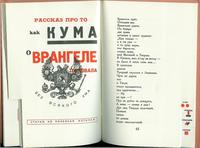
Illustration to 'For the voice' by Vladimir Mayakovsky
El Lissitzky
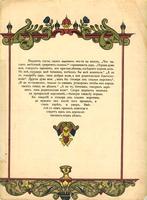
Illustration to 'Wooden Eagle'
Heorhiy Narbut
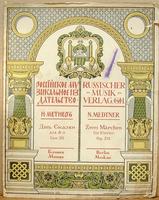
N. Medtner. Two tales
Ivan Bilibin
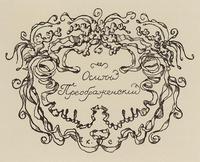
Exlibris of O. Preobrazenskiy
Konstantin Somov
Illustration to 'Bobeobi' by Khlebnikov
Nikolai Kulbin
Bookplate of V. I. Klochkov
Sergey Solomko
Illustration to 'Wooden Eagle'
Heorhiy Narbut
Exlibris of S. Mikhailov
Konstantin Somov
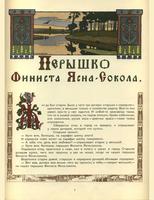
Illustration for the Russian Fairy Story "Feather Of Finist Falcon"
Ivan Bilibin
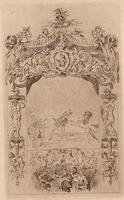
The Theatre Gaillard
Felicien Rops
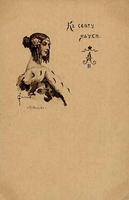
To the light of science
Sergey Solomko
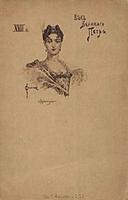
Age of the Great Peter
Sergey Solomko
Age of the Great Kings
Sergey Solomko
Lenin. Drawings by Nathan Altman.
Nathan Altman
Illustration to 'Wooden Eagle'
Heorhiy Narbut
Age At the dawn of history. Amazon.
Sergey Solomko
Illustrations for Mikhail Stelmakh's book "In the Hedgehog's Windmill"
Hryhorii Havrylenko
Age of Vladimir and Yaroslav
Sergey Solomko