
Analisi esperta di The Road to Sekerin di Konstantin Somov
Stile: Symbolism · Genere: landscape
Expert Analysis of "The Road to Sekerin" by Konstantin Somov
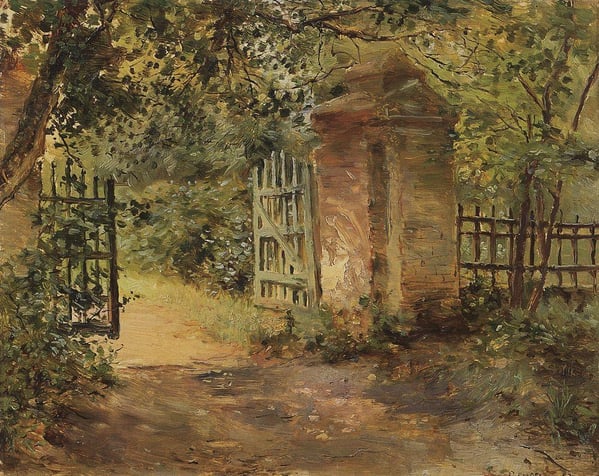
Konstantin Somov (1869–1939) was a leading figure of the Russian Symbolist movement and a core member of the Mir iskusstva (World of Art) group. His work consistently blurred the boundaries between reality and reverie, often infusing scenes of everyday life with an air of theatrical nostalgia, delicate irony, and profound psychological undertones. The Road to Sekerin—a landscape painting from his mature period—exemplifies these Symbolist preoccupations, even as it maintains the outward structure of a natural scene.
Significance within Symbolism and Its Period
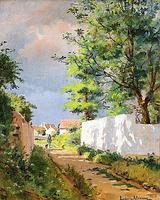
In Symbolist aesthetics, landscape was rarely just a depiction of nature; it served as a vessel for emotion, memory, and spiritual longing. Somov’s road—winding, uncertain, leading toward a hazy destination—functions as a classic Symbolist motif: the journey as metaphor. The painting captures a liminal moment, suspended between the familiar and the unknown, which aligns with the Symbolist fascination with thresholds, dreams, and the subconscious.
Somov’s technique further underscores this significance. He employs a refined, almost miniaturist precision in his rendering of foliage and paths, yet the atmosphere remains gauzy and slightly melancholic. This fusion of meticulous detail with a muted, silvery palette creates a sense of temporal dislocation—the scene feels both vividly present and hauntingly remote. It is this ability to evoke a subjective, interior mood through external observation that marks The Road to Sekerin as a quintessential Symbolist work.
Moreover, Somov’s landscape subtly references the 18th-century French fête galante tradition (especially Watteau), filtered through a distinctly Russian fin-de-siècle sensibility. The road itself becomes a stage, and the viewer is invited to imagine unseen figures—perhaps lovers, wanderers, or ghosts of a pastoral past—just beyond the frame. This interplay of visibility and concealment, reality and artifice, is central to Somov’s contribution to Symbolism.
Genre and Style
As a landscape, the work eschews the grand, epic vistas of Romanticism for an intimate, almost private view. The title “Sekerin” likely refers to a specific Russian estate or village associated with Somov’s aristocratic milieu. By choosing such a personal, non-monumental subject, he reinforces the Symbolist belief that the profoundest truths are found in the quiet, overlooked corners of the world. The road—unpopulated, winding into the distance—becomes a silent protagonist, embodying the Symbolist quest for meaning beyond the visible.
In sum, The Road to Sekerin is significant for its masterful translation of Symbolist ideals into a landscape format: it transforms a simple country path into an emblem of spiritual pilgrimage, nostalgia, and the elusive nature of beauty.
Visivamente simili
20 opere con composizione e palette affini
Clair De Lune À Camiers
Marie Duhem
The Garden Gate
Claude Monet
Homestead
Konstantin Makovsky
Old gates. Vel. Normandy.
Vasily Polenov
House with fence
Stefan Luchian
Shadows
Valeria Trubina
Boid-Guillaumi, near Rouen. A Gate Flanked by Two Posts
Camille Corot
Girls Working by the Gate
Nicolae Grigorescu
The Garden Gate at Vetheuil
Claude Monet
Kirkegaarden Paa Braatebakken
Theodor Severin Kittelsen
The Garden Gate, Epping
Lucien Pissarro
From Shade to Sunshine
Frederick George Cotman
Path and Gate in a Landscape
Leon Underwood
The gate
Santiago Rusinol
Entrance to the Voyer-d'Argenson Park at Asnieres
Vincent van Gogh
Man in the Moon
Robert Lewis Reid
Old Gates. Normandy.
Vasily Polenov
Parklandskap Med Figurer
Hans Gude
A path
Isaac Levitan
Homme Et Son Chien Dans Une Rue
Ludovic Alleaume