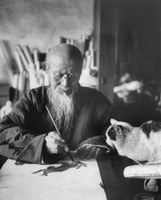
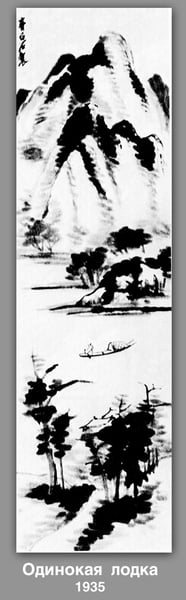
Analisi esperta di Lonely boat di Qi Baishi
Stile: Ink and wash painting · Genere: landscape
Expert Art Historical Analysis: "Lonely Boat" by Qi Baishi
Attribution and Context:
Qi Baishi (1864–1957) is one of the most revered figures in modern Chinese ink painting. Though best known for his vibrant depictions of flowers, insects, and shrimps, his landscapes reveal a profound mastery of the xieyi (freehand) tradition. "Lonely Boat" (孤舟) exemplifies his late-career synthesis of literati restraint and folk spontaneity, a hallmark that secured his legacy as a bridge between classical Chinese painting and modern expression.
Composition and Technique:
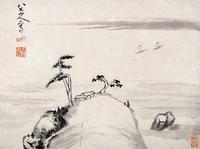
The painting is a study in economy: a single boat, likely rendered with a few swift, dry-brush strokes, sits or drifts amid vast expanses of unpainted silk or paper. Qi Baishi exploits the principle of liu bai (留白, "leaving white") to monumental effect—the negative space surrounding the boat suggests infinite water and sky, evoking the solitude of a lone traveler on a river or lake. A single, faint wash of ink might indicate distant mist or a far shore, while the boat’s occupant (if present) is only implied, never detailed. This reduction to essential forms is a direct inheritance from Song dynasty monochrome landscape ideals, but Qi Baishi infuses it with a rustic directness—his brushwork retains the liveliness and slight irregularity of amateur "scholar-painter" traditions, deliberately avoiding slick academic polish.
Symbolism and Significance:
"Lonely Boat" participates in a venerable Chinese pictorial tradition: the solitary vessel as a metaphor for the recluse or the transient nature of human existence—a theme explored by poets like Liu Zongyuan ("A thousand mountains with no bird flying / A thousand paths with no man's trace / A lonely boat, bamboo hat, an old man / Fishing in the cold river snow"). Qi Baishi, however, strips the scene of any overt narrative or moralizing. The boat’s loneliness is not tragic but serene, reflecting the artist’s own late-life synthesis of Daoist detachment and earthy vitality. By leaving the empty space unmarked, he invites the viewer to project their own emotional response—a direct communion between artwork and observer that anticipates modernist minimalism.
Why It Matters:
Qi Baishi’s "Lonely Boat" is significant for three reasons:
- Innovation within tradition – He revitalized classical ink landscape by merging literati elegance with the bright, folk-art sensibility he absorbed from his early years as a woodcarver and seal-cutter. The boat’s simplified form feels both timeless and immediate.
- Mastery of suggestion – Unlike his contemporaries who often loaded their landscapes with dense ink or color, Qi Baishi proves that the most powerful emotion can arise from the absence of detail. This work is a textbook example of the aesthetic principle that "less is more" (jian) in Chinese art.
- Cultural bridge – As a self-taught artist who rose from poverty to become president of the Beijing Art School, Qi Baishi democratized literati painting. "Lonely Boat" carries no aristocratic pretension; it speaks a universal language of solitude and inner peace, which resonates as much in the modern era as it did in ancient China.
In summary, "Lonely Boat" is not merely a depiction of a vessel—it is a Taoist koan in ink, a pause in a chaotic world, and a testament to Qi Baishi’s genius for making the minimal monumental.
Visivamente simili
20 opere con composizione e palette affini
Landscape (Dong Yuan and Juran Style)
Bada Shanren
Landscape
Tomioka Tessai
Mists on the mountain
Shitao
Landscape (Juran Style)
Bada Shanren
A friend of solitary trees
Shitao
Twilight Pines
Qi Baishi
Landscape (Album Leaf)
Bada Shanren
Autumn Mountains after Wang Meng
Lan Ying
Mountains High and Streams Eternal
Wu Guanzhong
Landscape of Pine Valley
Chen Hongshou
Haboku sansui
Sesshu Toyo
Conversation with the mountain
Shitao
Village at the foot of the mountains
Shitao
Earthly paradise and sacred mountains
Tomioka Tessai
Go by the cold paths
Shitao
The drunk poet
Shitao
Between mountain and river, not far from Mount Huang
Shitao
Light of dawn on the monastery
Shitao
Landscape
Lan Ying
Trees in a River Valley in Yü shan
Ni Zan