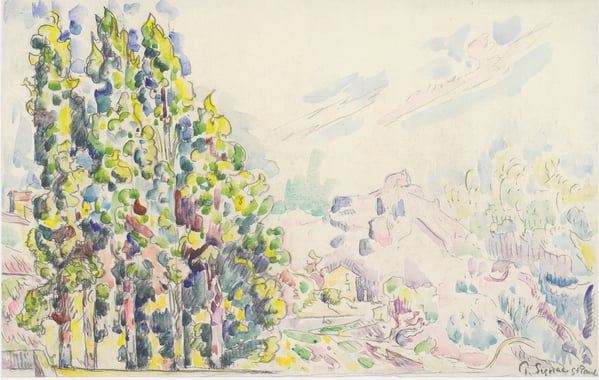
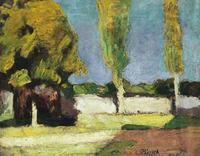
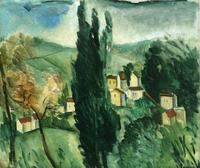
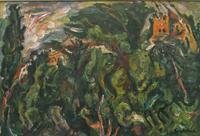
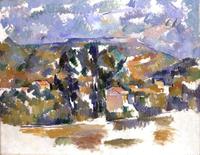
Paul Signac’s Saint Paul de Vence is a quintessential example of Neo-Impressionism, the movement he championed after helping to define its systematic approach to color. While the work is classified under both Impressionism and Neo-Impressionism, its true significance lies in the latter: it demonstrates the rigorous, scientific application of color theory known as divisionism (or pointillism).
In this landscape, Signac does not simply capture the fleeting effects of light as an Impressionist might; instead, he builds the entire scene from meticulous, separate touches of pure pigment. The viewer’s eye performs the optical mixing of these dots to perceive the luminous, shimmering atmosphere of the southern French town. This technique elevates the genre of landscape painting to a study in optical science, making Saint Paul de Vence not just a depiction of a place, but a demonstration of how color and light can be deconstructed and recomposed on the canvas. It represents the culmination of the Neo-Impressionist ideal—using an orderly, almost scientific method to achieve a vibrant, harmonious vision of nature, distinct from the spontaneity of earlier Impressionist works.