
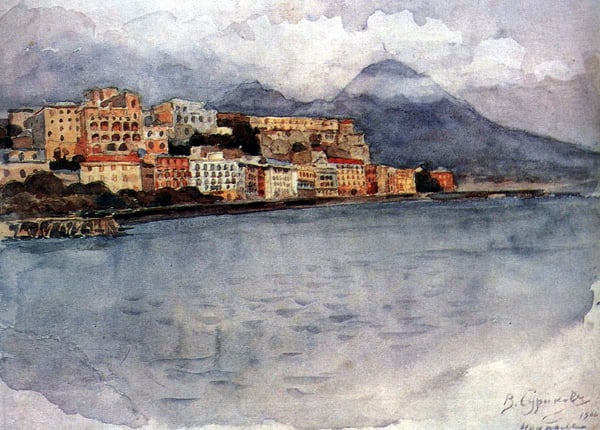
Expert analysis of Vasily Surikov’s Naples
Style: Realism · Genre: landscape
Expert Analysis: Naples by Vasily Surikov
Vasily Surikov is celebrated primarily for his monumental history paintings—such as Morning of the Streltsy Execution and Boyarynya Morozova—that vividly capture the drama and turmoil of Russia’s past. However, his lesser-known landscape Naples reveals a different facet of his artistic mastery, demonstrating that his command of realism extended beyond narrative scenes into the pure observation of nature and urban geography.
Stylistic and Period Context
Painted in the Realist tradition, Naples adheres to the movement’s core commitment to depicting the everyday world with fidelity and without idealization. Surikov treats the Italian coastal city with the same meticulous attention to light, atmosphere, and material texture that he applied to the snow-covered streets of Moscow. The work is significant because it shows Surikov stepping outside his usual Russian subject matter to engage with the Mediterranean landscape, yet still applying the rigorous observational principles of Russian Realism.
What Makes the Artwork Significant
-
An Intimate Glimpse of Surikov’s Travel – In the 1880s, Surikov traveled through Europe, and Naples captures his direct response to the southern landscape. Unlike his grand historical compositions, this landscape offers a more personal, unposed view, suggesting that the artist was not solely a chronicler of national history but also a sensitive observer of foreign scenery.
-
Mastery of Atmospheric Realism – Surikov’s handling of the Neapolitan light and air is notable. The warm, hazy luminosity of the Bay of Naples contrasts sharply with the crisp, cold light of his Siberian scenes. This demonstrates his versatility in adapting his Realist technique to different climates and lighting conditions.
-
Integration of Genre and Landscape – While classified as a landscape, Naples often includes subtle human elements (figures on a quay, boats in the harbor) that anchor the natural vista in lived experience. This echoes Surikov’s larger artistic concern: placing human activity within a tangible, sensory world.
-
Demonstration of Technical Range – Surikov’s ability to render water reflections, stone architecture, and the hazy silhouette of Vesuvius shows that his skill extended beyond figural composition. The painting is a testament to his draftsmanship and his nuanced color palette—predominantly blues, ochres, and soft whites that evoke the Mediterranean.
Conclusion
Naples is significant not as a deviation from Surikov’s main oeuvre, but as a complement to it. It proves that his realism was not simply a vehicle for historical storytelling; it was a deeply felt way of seeing the world in all its variety. For admirers of Surikov, this work enriches our understanding of the artist as a complete realist—one who could find the epic not only in Moscow’s tragedies but also in the quiet, sunlit shores of southern Italy.
Museum / Gallery
Visually similar
20 works with related composition and palette
Naples. Vesuvius.
Vasily Surikov
Gulf near Naples
Franz Ludwig Catel
View of Naples
Rudolf von Alt
On the beach of Santa Lucia in Naples
Rudolf von Alt

The gulf of Naples
Gabriele Smargiassi
Festival in Naples
Oswald Achenbach
Feuerwerk vor Neapel
Oswald Achenbach
Capri
Konstantin Gorbatov
View of Posillipo and the Bay of Mergellina
Franz Ludwig Catel
View of Amalfi
Konstantin Gorbatov
View Of Amalfi
Konstantin Gorbatov
From the Harbour at Naples, Gathering Storm
Franz Ludwig Catel
Sunset Over The Bay Of Naples
Oswald Achenbach

Molo Borbonico Napoli
Amalia Senatore

Town at the Seashore
Tivadar Kosztka Csontvary
View of Amalfi with boats
Vincenzo Caprile
Naples from the coast of Chiaia
Ippolito Caffi
Amalfi
Konstantin Gorbatov
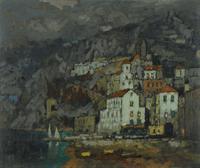
A View of Amalfi
Konstantin Gorbatov
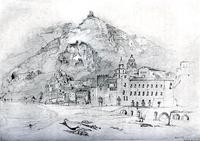
Amalfi
John Ruskin