Analisi esperta di Tsarevna di Vasily Surikov
Stile: Realism · Genere: sketch and study
Expert Analysis: “Tsarevna” by Vasily Surikov (Sketch and Study, Realism)
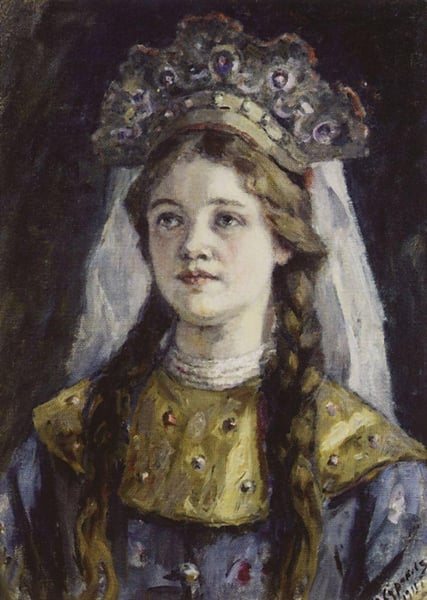
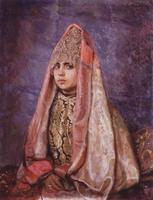
As a preparatory sketch in the Realist tradition, Vasily Surikov’s “Tsarevna” offers invaluable insight into the artist’s rigorous working method and his dedication to historical authenticity. Surikov, best known for monumental history paintings such as Boyarynya Morozova and The Morning of the Streltsy Execution, consistently employed detailed studies to capture the physical presence, costume, and psychological depth of his figures.
Significance within Realism and Surikov’s Oeuvre:
-
Historical Accuracy as a Realist Imperative
Realism demanded not only truthful depiction of contemporary life but also—in the hands of history painters like Surikov—a scrupulous reconstruction of the past. This study of a tsarevna (a Russian princess of the pre-Petrine era) reflects Surikov’s deep research into 17th-century court attire, textiles, and jewelry. Every fold of the brocade garment, the precise shape of the kokoshnik headdress, and the arrangement of pearls and embroidery is rendered with ethnographic precision, grounding the image in documented fact rather than romantic fantasy. -
The Role of the Sketch in Realist Practice
While often exhibited as a finished work would be, a study like “Tsarevna” serves as a record of Surikov’s process. It reveals his interest in capturing a specific type—whether a model posed in costume or a composite from historical sources—before translating that image into a larger composition. The brushwork is freer and more direct than in his finished canvases, allowing the viewer to observe how he built form with light and shadow. This sketch is thus a window into the artist’s decision-making, showing how he balanced naturalistic portrayal with compositional needs. -
Psychological Nuance in a Type
Though a study of “type” rather than a named individual, Surikov invests the tsarevna with a distinct emotional quality. Her gaze is both proud and introspective, conveying the constrained dignity of noble women in Muscovite society. This subtle psychology—the blend of grandeur and melancholy—echoes themes found in his major works, where historical figures are portrayed as complex human beings shaped by their time and fate. -
Contribution to the Russian Historical Genre
Surikov’s studies are crucial for understanding how Russian Realist artists approached national history. Unlike the academic idealism of earlier generations, Surikov’s Realism insists on the tangible, the flawed, and the culturally specific. “Tsarevna” exemplifies this: it is not a generic “beautiful woman” but a precise evocation of the dress, posture, and aura of a bygone era. It stands as a testament to Surikov’s belief that truth to historical detail was essential for conveying the emotional and moral weight of Russia’s past.
In summary, “Tsarevna” is significant as both a product and a process of Realism. It demonstrates how Surikov married documentary accuracy with painterly expression, elevating the preparatory study to an object of artistic and historical value in its own right.
Visivamente simili
20 opere con composizione e palette affini
Cup of honey
Konstantin Makovsky
Boyaryshnya
Konstantin Makovsky
Boyaryshnya
Konstantin Makovsky
Girl in Oriental Dress
Konstantin Makovsky
Portrait of the Girl in a Russian Dress
Konstantin Makovsky
Boyaryshnya
Konstantin Makovsky
Russian Beauty
Konstantin Makovsky
Boyaryshnya
Konstantin Makovsky
Portrait
Konstantin Makovsky
Portrait of Princess Zinaida Yusupova
Konstantin Makovsky
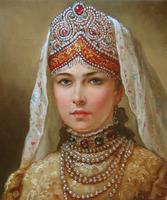
Girl in Russian outfit
Andrey Shishkin
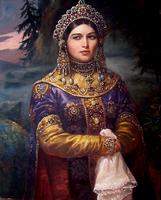
Mistress of the Copper Mountain (by Vasnetsov)
Andrey Shishkin
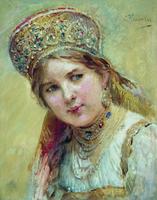
Boyaryshnya
Konstantin Makovsky

Young Lady Looking into a Mirror
Vladimir Makovsky
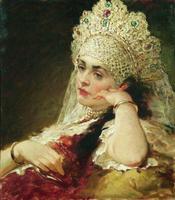
The girl in pearl necklace
Konstantin Makovsky
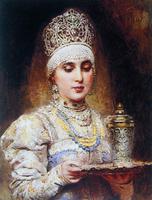
Boyaryshnya with a Tray
Konstantin Makovsky
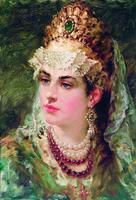
Boyaryshnya
Konstantin Makovsky
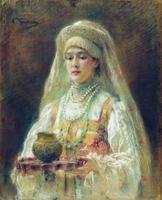
Cup of Honey
Konstantin Makovsky
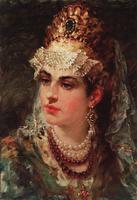
Portrait
Konstantin Makovsky
Portrait of V. Mamontova
Viktor Vasnetsov