Expert analysis of Vasily Surikov’s Yenisey near Krasnoyarsk
Style: Realism · Genre: landscape
Expert Analysis: "Yenisey near Krasnoyarsk" by Vasily Surikov
Artwork: Yenisey near Krasnoyarsk
Artist: Vasily Surikov
Style: Realism
Genre: Landscape
Vasily Surikov is celebrated as one of Russia’s greatest history painters, known for monumental canvases like Boyarynya Morozova and The Morning of the Streltsy Execution. However, Yenisey near Krasnoyarsk reveals a more intimate and personal side of the artist—a pure landscape executed with the unflinching clarity of Realism. This work is significant for several reasons, both within Surikov’s career and within the broader context of 19th-century Russian landscape painting.
1. A Return to Siberian Roots
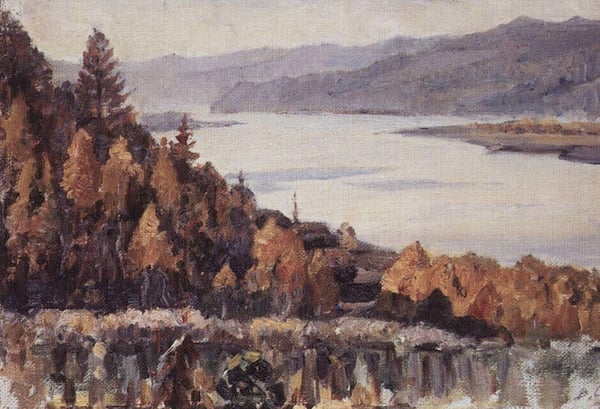
Surikov was born in Krasnoyarsk, a city on the Yenisey River in Siberia. Unlike many Russian Realists who focused on the European heartland or the picturesque countryside of the south, Surikov turned his gaze to the rugged grandeur of his native Siberia. This painting captures the powerful, untamed spirit of the Yenisey—its wide, slow-moving waters, the steep rocky banks, and the vast, open sky. It is not a sentimental or idealized view; rather, it is a truthful, almost geological observation of a specific place. For Surikov, this landscape was a touchstone of memory and identity, grounding his historical work in a tangible sense of place.
2. Realism in Service of Atmosphere
The work exemplifies the core tenets of Realism: rejection of romantic exaggeration in favor of precise observation, attention to natural light, and a focus on the ordinary. Surikov masterfully renders the subtle gradations of the river’s surface—the reflections of the sky, the ripples of current—and the dry, earthy tones of the cliffs. There is no dramatic storm or sublime sunset; instead, the painting conveys the quiet, almost meditative presence of the Siberian wilderness. The Realist palette is restrained, using greens, browns, and blues to build a cohesive, believable environment.
3. Significance as a Counterpoint to Surikov’s History Paintings
This landscape is not merely a scenic exercise; it serves as a vital counterpoint to Surikov’s dramatic historical scenes. In his major works, the landscape often functions as a silent, powerful character—the snowy streets of Boyarynya Morozova, the execution ground of Streltsy. Yenisey near Krasnoyarsk allows us to see how Surikov studied nature directly: his sensitivity to horizon lines, weather, and the scale of human presence (or absence) within the land. The empty riverbank here anticipates the solitary figures and vast spaces of his later compositions.
4. National and Regional Identity
In 19th-century Russia, landscape painting played a crucial role in defining national identity. While artists like Ivan Shishkin painted the dense forests of the north, and Isaac Levitan captured the lyrical, melancholy moods of central Russia, Surikov offers a distinctly Siberian vision. It is a landscape of extremes—cold, remote, and monumental—yet rendered with affection and precision. This work thus contributes to a broader understanding of Russia’s diverse geography, moving beyond the familiar to include the raw beauty of its eastern frontier.
Conclusion
Yenisey near Krasnoyarsk is significant because it reveals Vasily Surikov as a master of Realist landscape, a side of his oeuvre that complements and enriches his more famous historical narratives. It is a personal, topographic portrait of his homeland, executed with the same uncompromising honesty that defines his great history paintings. For the viewer, it offers a window into the Siberian landscape that shaped one of Russia’s most important artists, and it stands as a testament to the power of Realism to find profound beauty in the simple, unadorned truth of nature.
Visually similar
20 works with related composition and palette
Mountains near Krasnoyarsk
Vasily Surikov
The River Oka
Vasily Polenov
Autumn
Mikhail Olennikov
The purple noon’s transparent might
Arthur Streeton
Qudyalchay coast
Sattar Bahlulzade
Indian summer
Vasily Polenov
Landscape at Vernon
Pierre Bonnard
Green noise
Arkady Rylov
The river valley
Vasily Polenov
Yenisey
Vasily Surikov
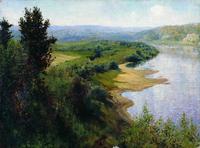
A river
Vasily Polenov
Oka near Tarusa
Vasily Polenov
Sednіv
Serhij Schyschko
Унылая Пора Очей Очарованье
Vitold Byalynitsky-Birulya
The everlasting hills
Julian Ashton
River Belaya
Mikhail Nesterov
Green noise
Arkady Rylov
The left bank of the Yenisei. Kolkhoz 'Luck'.
Pyotr Konchalovsky
Evening at Volga
Isaac Levitan
Autumn in the village. Open spaces
Mikhail Olennikov