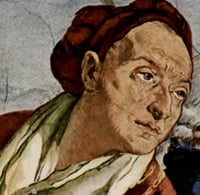
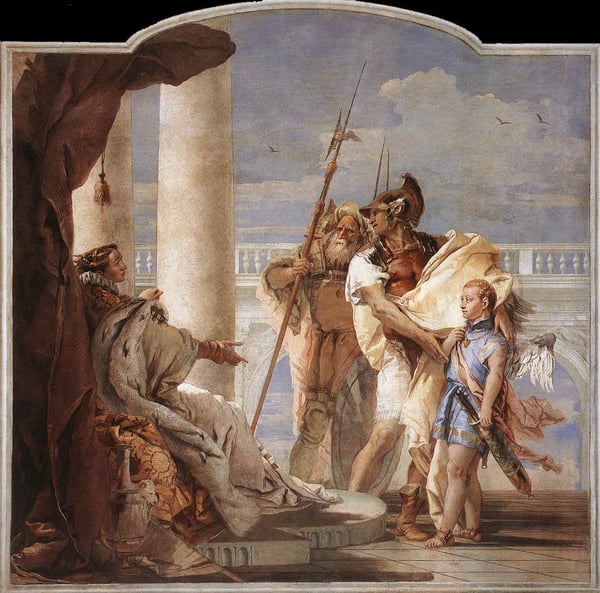
Analisi esperta di Detail of Dido, from Aeneid Presents Cupid, Disguised as Ascanius, to Dido di Giovanni Battista Tiepolo
Stile: Rococo · Genere: mythological painting
Expert Art Historical Analysis
Giovanni Battista Tiepolo’s Detail of Dido, from Aeneid Presents Cupid, Disguised as Ascanius, to Dido exemplifies the Rococo style’s capacity for theatrical grandeur, light-filled elegance, and narrative sophistication. Painted during the height of Tiepolo’s career, this work draws on Virgil’s Aeneid—specifically the moment when Venus sends Cupid in the guise of Ascanius to make Dido fall in love with Aeneas. The choice of a classical mythological subject is typical of Rococo, which often blended erudition with sensual delight, but Tiepolo elevates it through his signature bravura brushwork and luminous palette.
Significance within Rococo
Tiepolo is considered the supreme master of Rococo fresco painting in Venice, and this detailed study reveals his genius for capturing psychological tension within a radiant, decorative surface. The focus on Dido herself highlights the Rococo interest in private emotion and feminine grace: she is portrayed not as a tragic queen but as a figure of poised vulnerability, her expression combining curiosity and dawning enchantment. The soft, pearly tones of her drapery and the delicate handling of light on her skin demonstrate Rococo’s preference for pastel hues and sfumato-like transitions over the heavier chiaroscuro of Baroque predecessors.
Technical and Narrative Mastery
Tiepolo’s handling of the detail allows us to see his economical yet expressive brushwork: the swift, confident strokes that define Dido’s silks and the subtle modeling of her face. The artist’s ability to infuse a moment of cunning dramatic irony (the viewer knows Cupid is disguised) with a sense of airy lightness is a hallmark of Rococo. The composition, even in this fragment, suggests the larger stage of the palace interior, with space opened by implied perspective and a sky evoked in the background—typical of Tiepolo’s ability to dissolve walls into celestial vistas.
Legacy
This work is significant because it encapsulates the Rococo’s move away from the solemnity of history painting toward a more playful, psychologically nuanced, and visually sumptuous narrative. Tiepolo’s Dido is not a monument of ancient tragedy but a living presence, rendered with a lightness that belies the serious consequences of the episode. It stands as a testament to how Rococo artists could treat classical mythology with both decorative charm and penetrating human insight.
Visivamente simili
20 opere con composizione e palette affini
Sacrificio Di Polissena
Giambattista Pittoni
Il Sacrificio Di Polissena
Giambattista Pittoni
A Venetian Scene
Richard Parkes Bonington
Generosity of Scipio
Peter Paul Rubens
Scipio Africanus
Theodoor van Thulden
The Banquet of Cleopatra
Giovanni Battista Tiepolo
Rinaldo observed by Carlo and Ubaldo
Giovanni Battista Tiepolo
The Death of Germanicus
Nicolas Poussin
Scipio and a Slave
Giovanni Battista Tiepolo
Alexander the Great in the Temple of Jerusalem
Sebastiano Conca
Saint Eustace
Giambattista Pittoni
Death of Dido
Giovanni Battista Tiepolo
David Och Saul
Sebastiano Conca
Rinaldo Abandoning Armida
Giovanni Battista Tiepolo
Das Opfer Des Seleukus Von Lokris
Domenico Beccafumi
The Death of Sophonisba
Giovanni Battista Tiepolo
Psyche's Parents Offering Sacrifice to Apollo
Luca Giordano
Aeneas at the Court of Latinus
Ferdinand Bol
Request of Brabant to Join the Staten
Theodoor van Thulden
The abduction of the Sabinas
Peter Paul Rubens