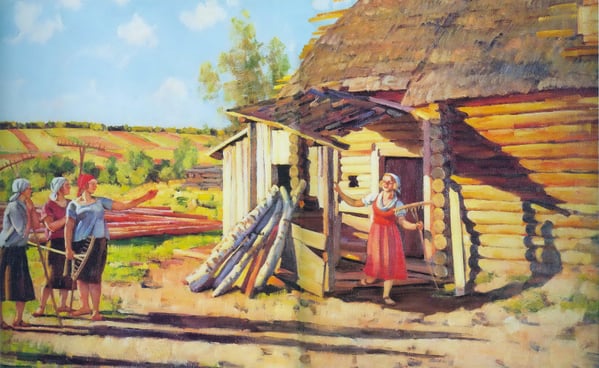
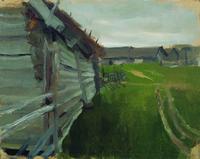
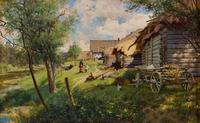
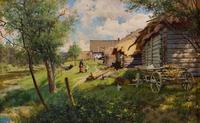
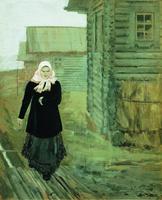
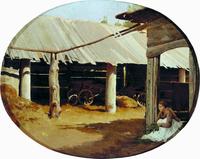
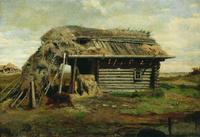
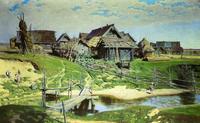
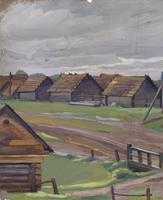
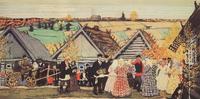
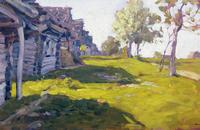
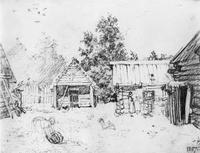
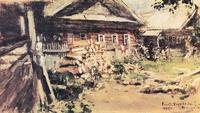
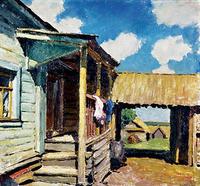
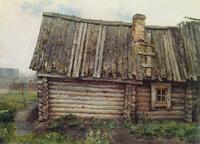
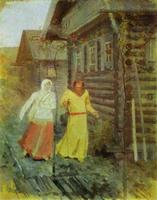
This painting by Konstantin Yuon, titled "The first collective farmers. In the rays of the sun. Podolina. Mosk. reg.", is a quintessential example of Socialist Realism—the official art style of the Soviet Union that demanded an idealized, heroic, and optimistic portrayal of socialist life. Its significance lies in how it transforms a specific agricultural scene into a visual manifesto for the collectivization campaign of the 1930s.
The title itself anchors the work in a particular time and place—the Moscow region (Podolina)—but the “rays of the sun” lift it from mere documentation into allegory. Yuon uses natural light not just as a plein-air effect but as a symbol of the bright communist future. The “first collective farmers” are shown not as laborers enduring hardship, but as pioneers bathed in a golden, almost sacred glow. This alignment of man and nature, with the sun blessing their toil, fulfills Socialist Realism’s core requirement: to show life “in its revolutionary development,” meaning the present is always already triumphant and heading toward an even better tomorrow.
As a genre painting, the work avoids the bombast of monumental history painting, instead depicting everyday work as a dignified, even joyous act. Yuon, a master of landscape and genre scenes, here merges his impressionistic sensitivity to light with the ideological clarity demanded by the state. The painting is significant because it encapsulates the tension between artistic pleasure and political duty: the sunlight feels authentic and painterly, yet it relentlessly serves the narrative of socialist progress. It is a perfect artifact of how Socialist Realism could naturalize ideology—making the collective farm not an imposed system, but a radiant, inevitable part of the Russian landscape.