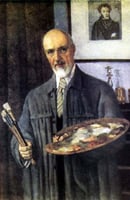
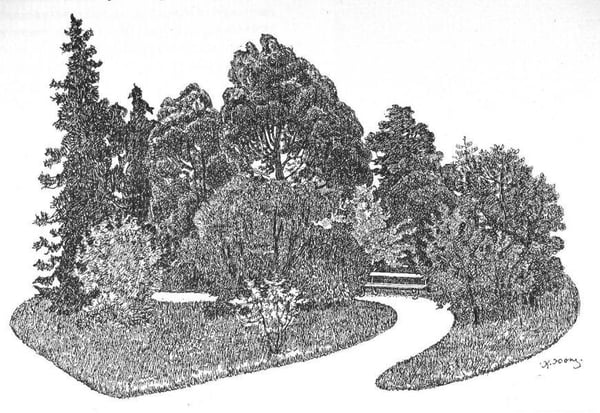
Analisi esperta di The Golden Fleece Magazine. The End di Konstantin Yuon
Stile: Art Nouveau (Modern) · Genere: illustration
Expert Analysis: "The Golden Fleece Magazine. The End" by Konstantin Yuon
Konstantin Yuon’s illustration for The Golden Fleece Magazine. The End is a striking example of how Art Nouveau (Modern) aesthetics were adapted within the Russian Symbolist movement. As a cover or closing illustration for the influential journal Zolotoye Runo (The Golden Fleece)—a key platform for Russian avant-garde artists and writers between 1906 and 1909—this work marks both a stylistic and thematic culmination.
Art Nouveau Elements & Composition
Yuon employs the hallmark Art Nouveau vocabulary: sinuous, organic lines that flow into decorative, almost calligraphic forms. The composition likely centers on an allegorical figure or ornamental border (typical of the magazine’s covers), with flattened planes of color and a preference for two-dimensional, stylized space over naturalistic depth. The use of botanical or floral motifs—a staple of the style—merges with a subtle Russian folk-art influence, seen in the bold outlines and rhythmic patterning. The title “The End” suggests a concluding statement, perhaps evoking the magazine’s final issue; Yuon may have imbued the scene with a sense of closure through a downward sweeping line or a fading figure, though the exact iconography remains within the Symbolist vein of melancholy beauty.
Significance
This illustration is significant for several reasons:
- Historical Context: The Golden Fleece was a crucible for Russian Modernism, bridging Western Art Nouveau and indigenous Symbolism. Yuon’s work here reflects the magazine’s mission to synthesize European decorative elegance with Russian spiritual and folk themes.
- Stylistic Synthesis: Yuon combines the fluid grace of Art Nouveau (as seen in the work of Alphonse Mucha or Aubrey Beardsley) with a distinctly Russian color sensibility—perhaps richer earth tones or jewel-like hues—creating a localized variant of the International Modern style.
- Narrative Role: As a magazine illustration, the piece functions both as autonomous art and as a designed object for print. Its title, “The End,” likely acknowledges the closing of a cultural chapter—the magazine ceased publication in 1909—making it a meta-commentary on artistic transience and the ephemeral nature of avant-garde print culture.
In essence, Yuon’s illustration encapsulates the ambitions of Russian Art Nouveau: to elevate commercial illustration to high art, to weave national identity into a pan-European decorative language, and to mark a poignant pause in the trajectory of early 20th-century modernism.
Visivamente simili
20 opere con composizione e palette affini
Edge of the Forest
Ivan Shishkin
Vaszary János, Park 1911
Vaszary János
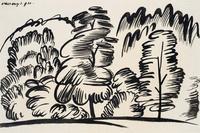
Vaszary János, Park 1911
Vaszary János
Trees at Evian
Avigdor Arikha
The sketch for the painting "Rye"
Ivan Shishkin
Bela Adalbert Czóbel, Forest
Bela Czobel
Trees
Hryhorii Havrylenko
Deciduous Forest
Ivan Shishkin
Mounds. The park.
Pyotr Konchalovsky
In the deciduous forest
Ivan Shishkin
Trees and fields
August Macke
Evening landscape
Hryhorii Havrylenko
Chestnut trees in the autumn in Antagnes, Switzerland
Hubertine Heijermans
Park
Paul Klee
The mounds. Edge of the Forest.
Pyotr Konchalovsky
Spring Landscape
Paul Nash
Village at the edge of forest
Isaac Levitan
Pines
Ivan Shishkin
Skaatoe
Theodor Severin Kittelsen
Izvarka
Nicholas Roerich