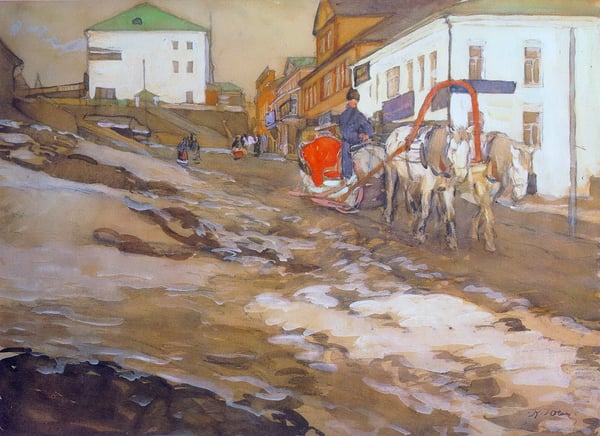
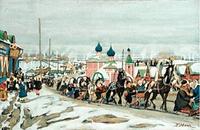
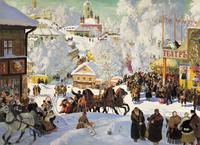
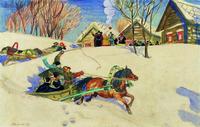
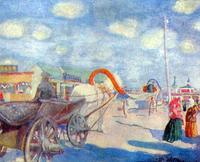
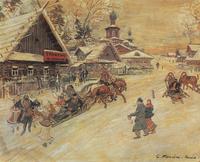
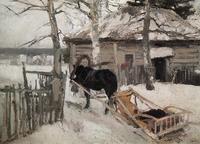
Based solely on the provided structured facts, the significance of Konstantin Yuon’s “The Red Sled. The Troitse-Sergiyev Tenements” lies in its synthesis of Post-Impressionist stylistic principles with the genre painting tradition. As a Post-Impressionist work, it likely emphasizes subjective expression, bold color choices (implied by the vivid “red” sled), and a departure from strict naturalism—characteristics that elevate a humble everyday scene. The genre painting classification anchors the work in the depiction of ordinary life, specifically the tenements and sledding activity, suggesting Yuon focuses on the simple, communal rhythms of Russian winter. The artwork’s significance thus arises from how it uses Post-Impressionist visual language—vibrant hues, expressive brushwork, and compositional freedom—to transform a mundane genre subject into a emotionally resonant and culturally specific snapshot, bridging the immediate, personal experience of the ordinary with the broader artistic concerns of early 20th-century modernist painting.