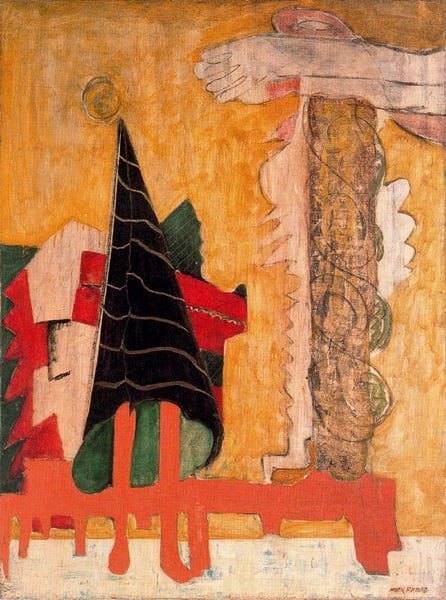
Analisi esperta di Sacrifice of iphigenia di Mark Rothko
Stile: Surrealism · Genere: figurative
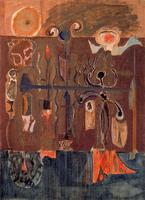
The significance of Sacrifice of Iphigenia lies in its demonstration of Mark Rothko—an artist synonymous with monumental abstract color-field painting—working within the distinct stylistic boundaries of Surrealism and figurative genre. Created during his early career (circa 1942), the work captures a pivotal moment before his breakthrough into pure abstraction. Here, Rothko employs Surrealist techniques such as biomorphic forms, ambiguous spatial depth, and a mythic or dream-like narrative, drawn from the classical Greek tragedy of Iphigenia. The figurative treatment of the subject—rare in his later oeuvre—shows his engagement with psychological archetypes and the unconscious, a central tenet of Surrealism. As a figurative Surrealist work by a painter who would later abandon representational imagery entirely, this painting is a crucial artifact of Rothko’s artistic evolution, illustrating how his early, narrative-driven style laid the groundwork for the emotional and spiritual intensity of his mature abstract works.
Museum / Gallery
Genere
Stile
Visivamente simili
20 opere con composizione e palette affini
Cin-Zin
Karl Knaths
Man with guitar
Pablo Picasso
Couple of dancers
Pablo Picasso
Secretary
Willem de Kooning
Landscape of Olympia
Yiannis Tsaroychis
Window opened to the street Penthieure
Pablo Picasso
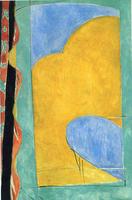
The Yellow Curtain
Henri Matisse
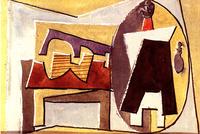
Untitled
Pablo Picasso
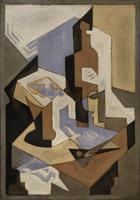
Composición Cubista Con Botella
Maria Blanchard
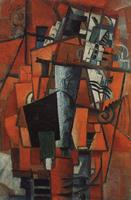
The lady at the piano
Kazimir Malevich
Harlequinesque personage
Pablo Picasso
Composition
Valerii Lamakh
Steeple and Street
Stuart Davis
Vertical figure
Gosta Adrian-Nilsson
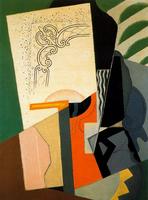
Composición Cubista
Maria Blanchard
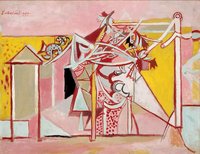
Pink Vine Pergola
Graham Sutherland
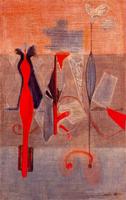
Primeval Landscape
Mark Rothko
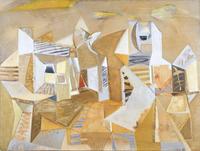
L’intérieur D’une Maison
Jacqueline Lamba
Fantasy
Mark Rothko
Bodegón
Maria Blanchard